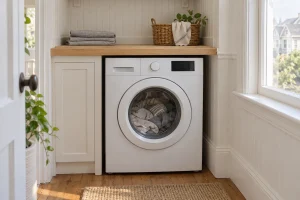
Washers
Asko 24-inch front-load washers we repair in San Francisco: lineup by series, door lock and drain complaints, E-codes and F-codes, and what…
Front-load washers that will not drain, lock, spin or fill, diagnosed in the closets and laundry nooks where they actually live.
Most of the Asko washers we visit sit in a hall closet, a laundry nook behind bifold doors or a stacked pair under a shelf in a flat that was never designed for laundry. The footprint is small, the floor may be a wood subfloor over someone else’s ceiling, and the drain is often a standpipe in the wall. That setting shapes almost every washer fault. When you book Asko washer repair, tell us where the machine lives, because access and drainage change what we bring.
Water that never leaves the drum is a drain complaint until proven otherwise. The drain pump filter behind the small hatch at the front of the cabinet is the first owner-cleanable suspect. After that come the drain hose, the standpipe and the pump itself. Washers with the W6461 label use F-numbers, and F3 is listed as a problem with the drain pump. Current washers show E-numbers; E7 is described as a draining error and E7.1 as reduced water flow in the pumping stage. The full walk-through is in Asko washer not draining.
A front-loader keeps its door locked while there is water inside, and a washer that believes the lock has failed will not start. Code lists for different platforms describe door lock errors, locking errors and unlocking errors separately: E2, E22, E23, E24 and E26. A gasket folded over the latch, a door slammed on a sock and a worn lock assembly all give a similar picture, so the door gets examined with the machine unplugged before a part is named. See Asko washer door won’t unlock for what you can try first.
Violent shaking is usually about balance and footing, and sometimes about the machine itself. A single heavy towel, uneven feet on a springy closet floor or transit hardware never removed after installation can all do it. E13 is described as unevenly distributed laundry on one platform, and E12 as a motor error on another. A drum that turns by hand but not under power points elsewhere than one that grinds. Our notes on Asko washer not spinning and Asko washer shaking and off balance go deeper.
A sour drum often comes from the gasket fold and the pump filter, covered in Asko front-load washer smell. Suds that climb the glass match E7.2, which the code list describes as an excessive amount of detergent. Slow or absent filling matches E3, water filling error, and calls for a look at the supply valves and the inlet screens.
Different Asko washer generations show different lists, so the meaning of a code depends on the machine. A few that people ask about most:
The complete set sits in Asko washer error codes. A code points to a system, not to a part number, and we confirm it with the machine open before quoting a repair.
Several installation habits cause repeat service calls:
Start with the plug and the breaker. Confirm both water taps on the wall are open and that neither hose is bent. Close the door properly and make sure nothing is trapped in the gasket. Open the pump filter hatch with a shallow dish and a towel ready, and clear what you find; this is the one cleaning job the machine is designed for. Write down the display code word for word. A single power reset, with the machine off for a short pause, can settle a communication glitch.
Leave the back and top panels alone. Do not bypass the door lock. If the drum is full of water, drain it through the filter hatch slowly rather than forcing the door.
Turn the taps off and unplug the washer if water spreads across the floor, if you see a drip from beneath the drum, or if you notice a burning odor. In a flat with neighbors below, do not wait for a second cycle. A short leak is much simpler to repair than a stained ceiling downstairs.
Washer parts and code lists vary between platforms, so we ask for the model before we arrive. The label is usually around the door opening. Models in our files include the Asko W4114C.W.U repair in the 5-series Logic range, the Asko W2084.W.U repair in the 3-series Classic range, the Asko W6098X.S/3 repair in the 7-series, and the Asko W6461 repair, which is no longer sold new. If you are unsure, how to find your Asko model number will help.
The technician checks the install first: levelling, hoses, standpipe, outlet. The fault is then reproduced if possible and the suspect circuit is tested. You are given a written estimate, you decide, and only an approved repair goes ahead. Afterward we run the machine through a short program to see it drain and spin.
See the lineup in Asko washers.
Turn the power off at the breaker for a short pause, switch it back on and try the door again. If water is still in the drum, drain it through the pump filter hatch first. A door that stays shut after that needs a technician, not force.
Common reasons are an unbalanced load, feet that are not level on a flexing closet floor, or shipping hardware left in from installation. If none of these apply and the noise is a grind, the machine needs a look.
Yes, it is designed for that. Unplug the washer, set a shallow dish and towel beneath the hatch, open it slowly and clear what is inside. Do not remove any other panel.
It changes how quickly a leak matters. Turn the taps off at once if you see water, and tell us about the layout when you book so the visit is planned around access.
No. It names the area where the control saw a problem, and the technician confirms the cause with tests. The estimate follows that confirmation.
Asko 24-inch front-load washers we repair in San Francisco: lineup by series, door lock and drain complaints, E-codes and F-codes, and what…
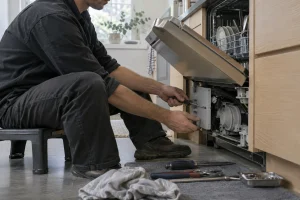
Diagnosis and repair for 24-inch built-in Asko dishwashers across San Francisco and the Bay Area, from drain faults and F-codes to leaks…
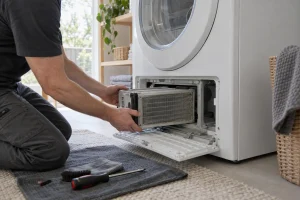
Vented and heat pump Asko dryer repair across San Francisco and the Bay Area: slow drying, filters, condensate trouble, door and sensor…
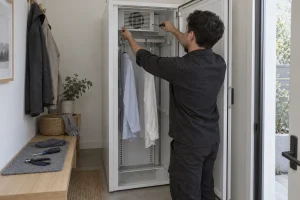
Repair for Asko drying cabinets in San Francisco homes: damp garments, moisture sensor and water tray codes, airflow and placement problems, written…
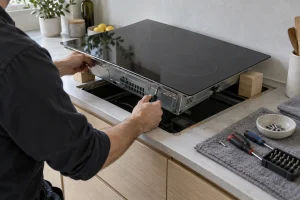
Asko induction cooktop repair across San Francisco: dead zones, pans not detected, shutdowns and unresponsive controls, with diagnosis first and your approval…
Share a few details and we’ll confirm an appointment. Prefer to talk? Call us and we’ll help right away.