

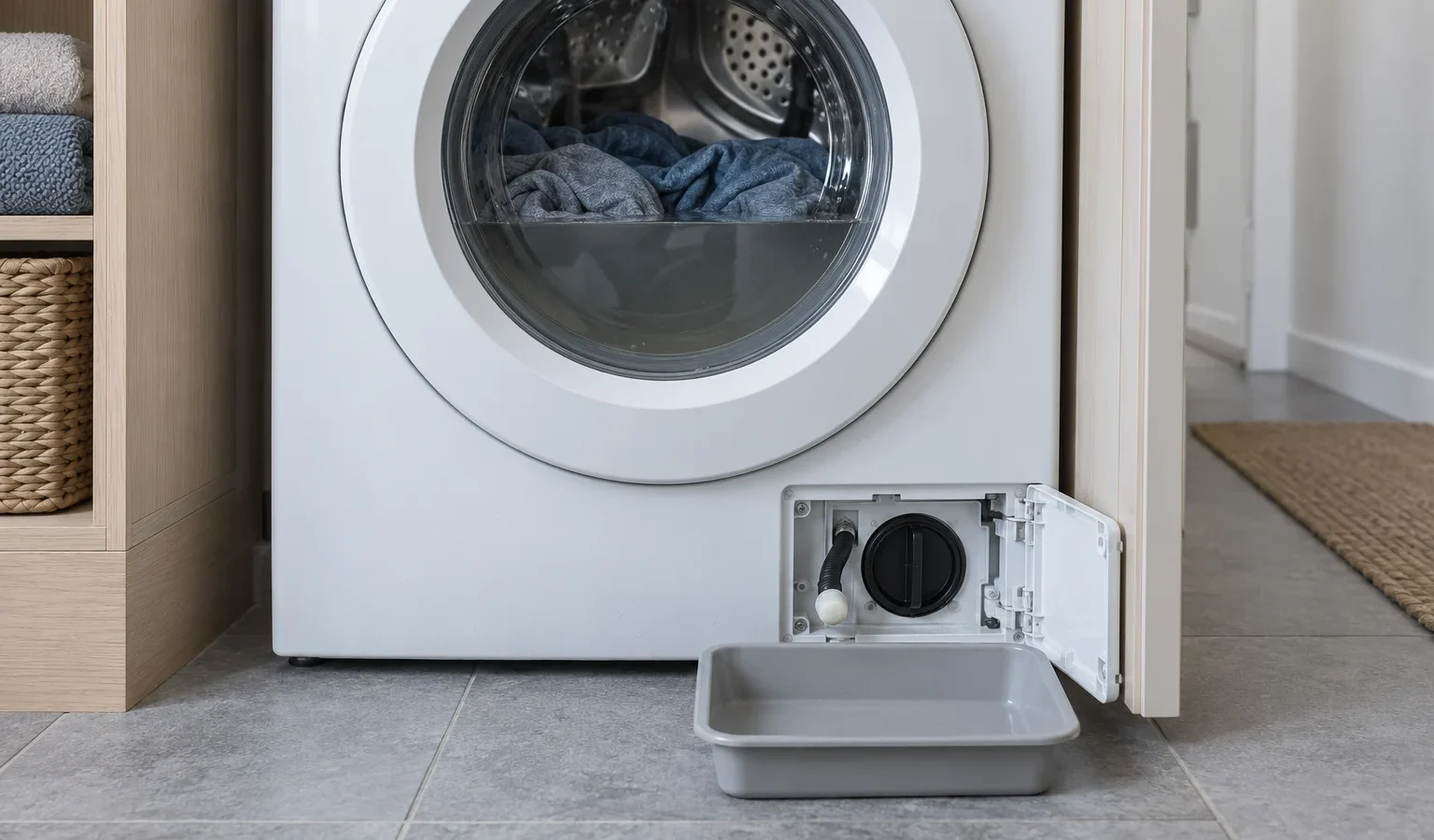
When an Asko front-load washer leaves water in the drum or stops before the spin, the pump filter, the drain hose height or the standpipe is often involved. A clear checklist follows.
You come back to find the cycle stopped, wet laundry still sitting in a pool of water and a code or flashing light on the panel. A front-load washer moves water out through a pump, a hose and a standpipe or a sink trap connection. When any part of that chain is blocked, kinked or set at the wrong height, the washer cannot finish the cycle, and the control stops it to avoid spinning a load that is full of water.
Look at how far the program got. If the washer filled and washed normally and then stopped at the first drain, the drain path is the obvious suspect. If the water level is high and the drum is hard to turn, the machine is holding a full load of water. If the display shows an E-number or F-number, it has recorded a drain fault. Some washers pause and retry the drain a few times before giving up, so give a stopped cycle a few minutes before you assume it is stuck.
In our library, E7 is a water draining error and E7.1 is a drain system alert that reports reduced water flow in the pumping stage, both listed for WM85.1 (and E7.1 also for WM75.B). On the W6461, F3 is a problem with the drain pump. An E7.1 alert in particular reads like an early warning, so a washer that still finishes slowly may be about to fail completely. For the full list across washer families, see the article on Asko washer error codes.
Do not go beyond this. Opening the cabinet or testing the pump while it is energized is a technician job.
A washer full of water will keep its door locked. Do not force the door. If the drum has water in it, use the filter drain approach in the manual only if you are comfortable doing it, with a tray under the filter and several towels. If water is not draining and the door will not release, our article on the washer door that will not unlock covers the waiting period and what a technician will check next.
Asko washers are 24-inch machines, and in San Francisco they are often placed in a hall closet or a laundry nook, sometimes with a dryer stacked above. In those spaces the drain hose has to turn tightly behind the machine, so one sharp bend can reduce flow. The standpipe or trap needs the right height and should not be sealed around the hose. In older buildings with shared stacks, a standpipe that is cut too low lets water run back or overflow, and one that is too high makes the pump work harder than it should. A new floor or a remodel can shift these heights. A technician checks the hose route, the standpipe and the pump together instead of assuming a pump fault.
Book if the filter is clean, the hose is clear and the house line drains but water remains; if the code returns; if the pump hums and nothing leaves; or if you notice a hot odor near the machine. Switch off at the breaker first. We diagnose before repairing, give a written estimate and carry out nothing without your approval. The technician will read the model number from the door opening, which helps with the pump type, whether it is a current W4114C.W.U or a discontinued W6461 that is no longer sold new. More on the process is on the Asko washer repair page, and the Asko washers guide shows the lineup.
Every load sheds lint, threads and the odd small object, and in a front-load washer these all travel the same way: through the drum perforations, into the tub and toward the pump. The filter exists to catch them before they reach the impeller. If it is never cleaned, it first slows the drain, then triggers a flow alert, and finally blocks the water completely. Households with children, pets or pockets full of tissues find it clogged sooner. Making a habit of cleaning it from time to time, following the manual, is one of the cheapest ways to keep a washer reliable.
Some washers retry the drain several times. Give it a few minutes, then switch it off and begin the checks if the water has not moved.
Yes. Small items slip past the drum perforations and reach the pump filter. A single sock, coin or hairpin there is enough to block flow.
The standpipe or the shared line may be partly blocked. If the sink is slow too, ask a plumber to clear the house drain before blaming the washer.
It is a warning of reduced flow. The washer may still finish cycles, but the blockage tends to get worse, so clean the filter and check the hose soon.
No. We diagnose first, give a written estimate, and repair only after you approve it.
Share a few details and we’ll confirm an appointment. Prefer to talk? Call us and we’ll help right away.