Dryers
Vented and heat pump Asko 24-inch dryers serviced across San Francisco: lineup, condensate and filter problems, E-codes and what you can safely…
Vented or heat pump, stacked or standing alone: dryers that run long, stay damp or show an E-code, diagnosed before repair.
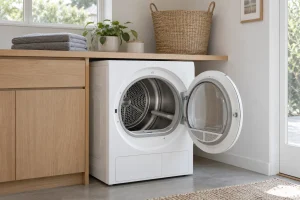
Asko dryers come in two kinds in the Bay Area, and the first question on every visit is which one you own. A vented dryer pushes hot, damp air out through a duct to the exterior. A heat pump dryer keeps its air inside a closed loop, condenses the moisture and either pumps it away or collects it in a container. No outside wall is needed for the second, which is why they turn up in condo towers and in-law units. Both are 24 inches wide in the models we hold on file, and both are covered by our Asko dryer repair service.
The Asko T411VD.W.U repair page covers one vented electric model in the 5-series Logic range. On a vented machine the complaint is nearly always airflow: a long duct run, a crushed elbow behind the closet wall, lint packed in the exterior hood or a flap that sticks shut. The machine heats, nothing leaves, and the load stays damp.
Heat pump models include the Asko T411HS.W.U repair, the Asko T208H.W.U repair in the Classic range and the Asko T7HXLW.U repair in the 7-series. These dry gently and take longer, so a slow cycle is not always a fault. When drying drops off over weeks, we look at the lint filter, the condenser filter and the condensate path before anything inside the cabinet.
These are E-numbers. The meanings below are what the code lists say for the platforms in question:
E4 is worth noting: the manual treats a clogged filter as a possible reason, which is why a cleaning comes before a call. All dryer codes are collected in Asko dryer error codes.
On a vented dryer the technician traces the air from the drum to the outside, and then looks at the heating circuit, the thermal protection and the motor. On a heat pump dryer the order is different: filters, condenser, condensate pump or container, sensors, and then the sealed heat pump unit, which only a trained hand should touch. We do not open the refrigerant circuit during a routine diagnosis; if the fault points there, you hear it from us with the reasoning, before any repair.
A written estimate arrives after diagnosis. Without your yes, the dryer stays as it is.
Clean the lint filter after each load. On a heat pump unit, clean the condenser filter too and empty the water container if there is one. On a vented unit, step outside and check that the vent hood flap swings freely. Look behind the dryer for a flattened duct or a kinked drain hose. Confirm the plug is seated and the breaker is on. Record the exact code. One controlled power reset is acceptable.
That is where owner work ends. Do not take the cabinet apart, do not clean the inside of the heat pump unit and do not run the dryer with the filter removed.
Stop the dryer and cut power at the breaker if the room smells of burning, if the cabinet is hot to the touch long after the cycle, or if the dryer trips a breaker more than once. Never leave a malfunctioning dryer running while you are out of the flat.
The label is usually inside the door opening. With the model in hand we know whether we are looking at a vented or heat pump machine and which code list applies; how to find your Asko model number shows where to look. A technician then arrives, inspects the installation and ventilation, finds the fault, writes the estimate and waits for your approval. For the whole range, see Asko dryers.
Look for a duct leading out of the back of the machine; that is a vented unit. A dryer with no duct and a water container or drain hose is a heat pump unit. The model label also tells us which one you have.
Heat pump dryers dry gently, so a longer cycle is normal. If cycles are getting longer over time, clean the lint filter and condenser filter, empty the container and check the drain hose.
No. The manual lists E4 as a control unit failure and advises cleaning the filters, so clean them first. If the code returns with clean filters, it needs diagnosis.
Only the filters, the container and the outside vent hood. Everything inside the cabinet, including the heat pump unit, is for a technician.
Yes. We check the washer’s footing and the stack as part of any dryer visit, because movement in one machine can look like a fault in the other.
Vented and heat pump Asko 24-inch dryers serviced across San Francisco: lineup, condensate and filter problems, E-codes and what you can safely…
Diagnosis and repair for 24-inch built-in Asko dishwashers across San Francisco and the Bay Area, from drain faults and F-codes to leaks…
Repair for Asko drying cabinets in San Francisco homes: damp garments, moisture sensor and water tray codes, airflow and placement problems, written…
Asko induction cooktop repair across San Francisco: dead zones, pans not detected, shutdowns and unresponsive controls, with diagnosis first and your approval…
Asko wall oven and combi-steam oven repair across San Francisco: no heat, uneven baking, weak steam and door faults, with a written…
Share a few details and we’ll confirm an appointment. Prefer to talk? Call us and we’ll help right away.