

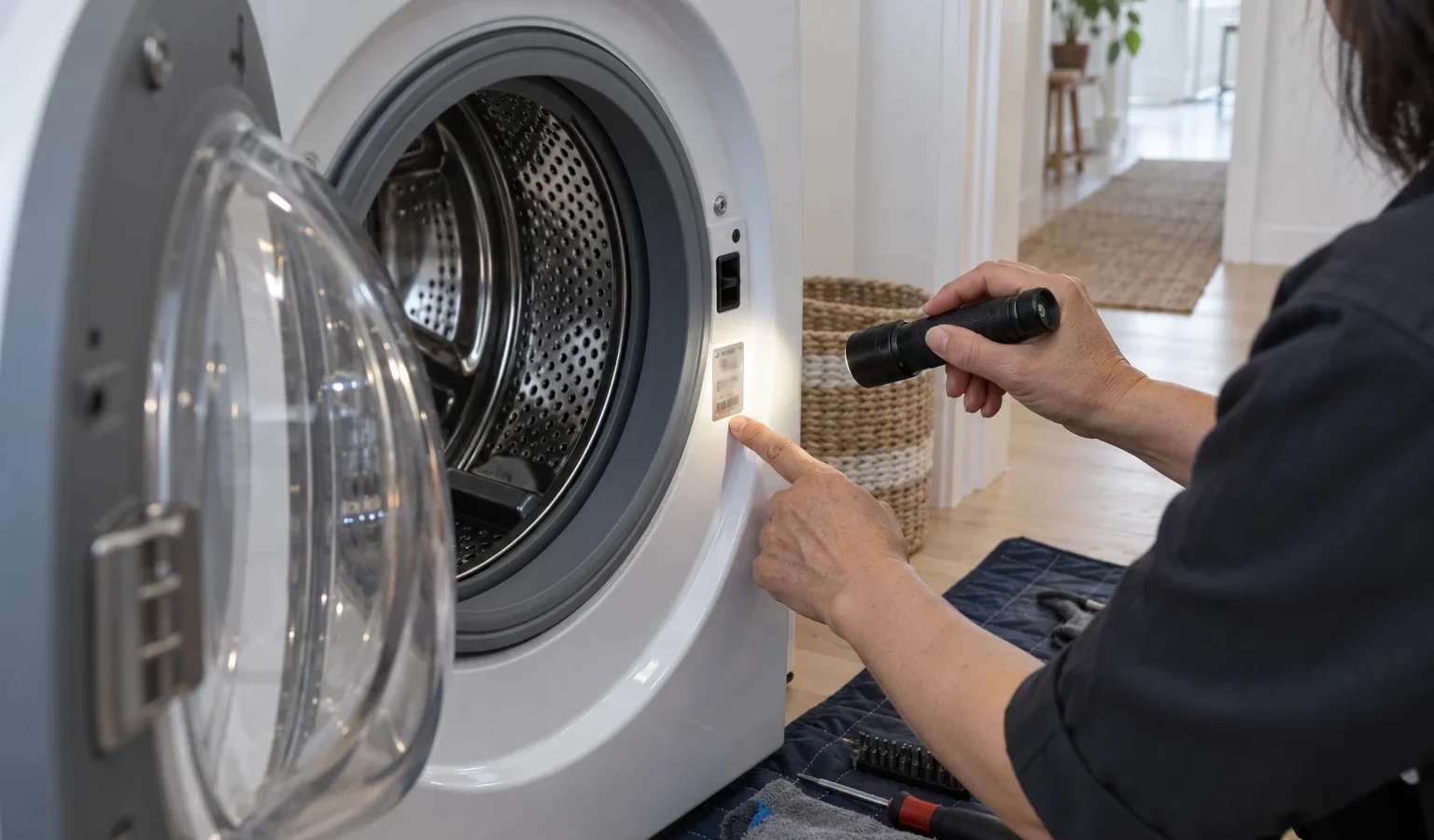
Technicians need the model number to match parts and codes. Here is where the label usually sits on each kind of Asko appliance, and how to record it clearly.
When you ask a technician about a fault, the first question after the symptom is the model number. It decides which parts are possible, which codes your display can show and which steps apply. Giving it up front shortens the first conversation and lets us prepare. The label that carries it is usually easy to find once you know where to look, and each appliance type has its own habits.
The data label is a sticker or plate with several lines of text. Among them is a model designation, often alongside a serial number and electrical details. Look for a line labeled model or type. Do not rely on a nickname from the brochure or on the name on the front panel; they can differ from the designation on the plate. Do not shorten or reformat what you read. Letters, digits, dots and dashes all count, and a missing character can lead to a different appliance.
Compact, built-in appliances are often tucked into tight spaces. In San Francisco, a dishwasher may sit between cabinets with no side access, a stacked washer and dryer pair may share a hall closet, and a cooktop is likely to be fixed into stone with a drawer beneath it. Do not pull a built-in unit from its position to read the label. Try these alternatives instead:
Take a photo of the label in good light and also type the model number into a note. Read the number slowly, and distinguish between the digit zero and the letter O, and between the digit one and the letter I. Many Asko designations include dots or dashes that separate parts of the number; copy them as printed. If the label shows several numbers, send them all and mark which one is next to the word model. A photo covers what the eye misses.
Using the number, we can confirm the appliance type, check which codes belong to it and prepare for the repair. We do not guess at features from the letters in a designation. Our library lists specific models on its Asko model pages pages, for example DC7784HP.W for a drying cabinet or WCN111942G for a wine cabinet. If yours is not listed, a visit still works: the label tells us what we need.
The same code can mean different things on different appliances, so write down the code and the model together. Dishwashers and older washers use F-numbers; current washers, dryers and drying cabinets use E-numbers; wine cabinets use short letter-and-digit codes. Our article on Asko drying cabinet error codes and the one on Asko wine cabinet error codes show how this works for two families.
Even a cleaning question or a noise complaint depends on the model, because the layout of filters, drain screens and vents differs between appliance types. A heat pump dryer needs a different set of checks from a vented dryer, and a drying cabinet differs from both. With the number in hand, we can tell you which filter or screen is yours to clean and which belongs to a technician.
If you look after several units, keep a simple record of each appliance: the type, the model number, the installation location and a photo of the label. When a tenant reports a fault, the record lets us arrive prepared, and it avoids repeated trips to read a label hidden behind a cabinet door. A shared note or spreadsheet is enough, and updating it after each visit keeps it useful.
When you request a visit across San Francisco or the Bay Area, include the model number, the serial number if visible, the symptom, any code and what you already checked. We diagnose before any repair, give a written estimate and do nothing without your approval. If you cannot find the label, tell us what the appliance is and where it is installed, and we will help you work it out.
No. The model number identifies the type of appliance; the serial number identifies your individual unit. Provide both if you can.
Use the one on the data label. Brochure names may be simplified.
Photograph whatever is readable, send what you can, and describe the appliance. We can often identify it from the details.
No. Do not move built-in units. Use paperwork or photos instead, or tell us at booking.
The same code can mean different things on different appliances, so the pair gives a clear answer.
Share a few details and we’ll confirm an appointment. Prefer to talk? Call us and we’ll help right away.