

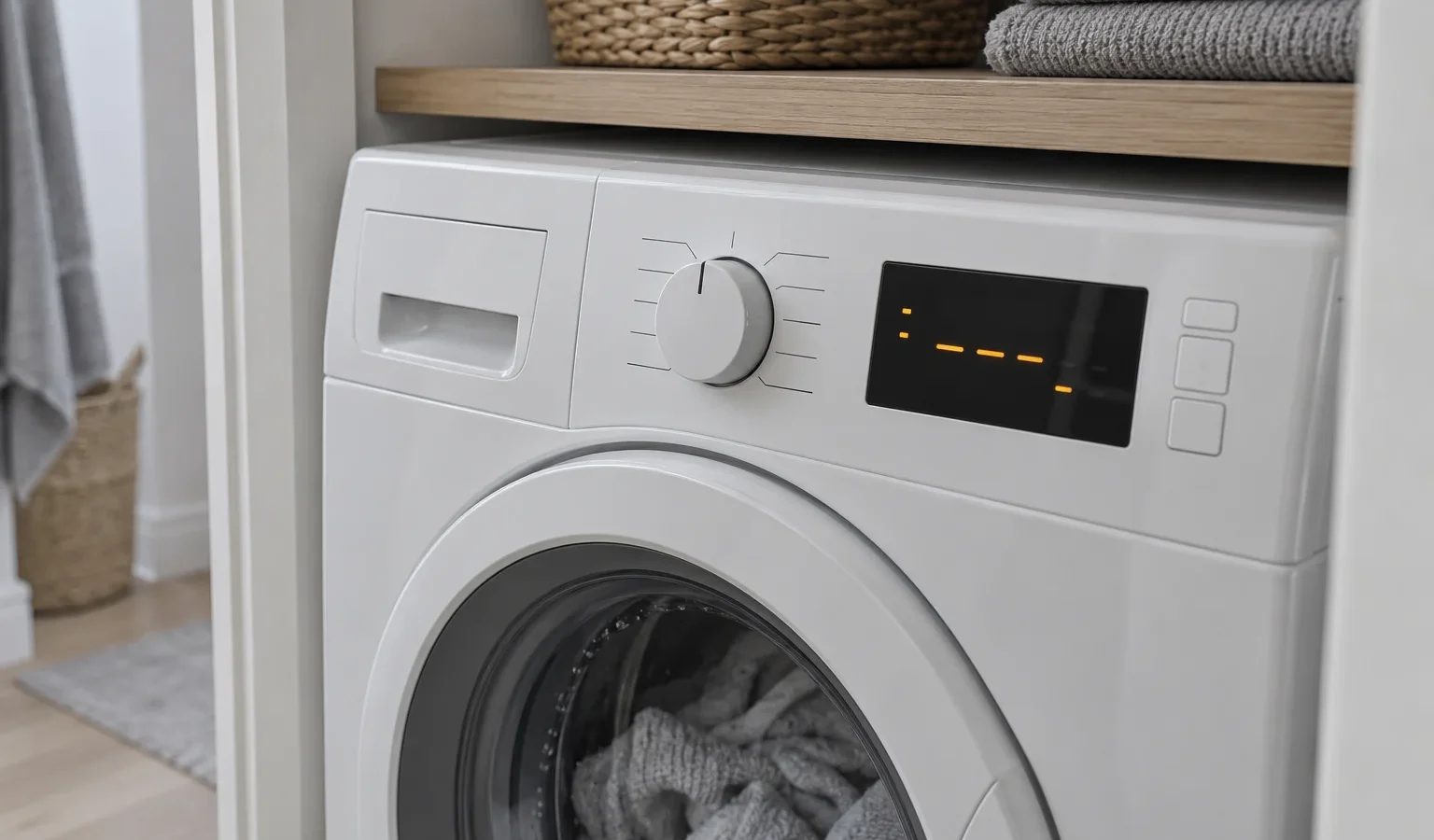
Asko washers show E-numbers on current models and F-numbers on older ones. This guide groups the codes by what they involve: water, doors, motor, sensors and communication.
An Asko washer reports a fault with a short code on the display. Current front-loaders mostly use E-numbers, some with a decimal such as E7.1, while an older model such as the W6461 uses F-numbers. The same number does not always mean the same thing on every washer, so our reference ties each meaning to the washer series it was verified for. That is why a code page lists “applies to” models, and why the technician confirms the reading at the machine.
Write down what the display shows before you do anything else. Note whether it flashes, whether the cycle stopped, whether there is water in the drum and whether the door is locked. Then do one controlled reset at the breaker. A code that does not return was likely temporary. A code that comes straight back is real, and repeated resets only waste time and sometimes leave water in the drum. If the code appears with an odd smell or noise, keep the breaker off.
For drain symptoms, see our article on a washer that is not draining. For leaks, close the supply valve and switch off at the breaker before you do anything else.
E2 is a door lock error. E22 says the door is closed but cannot be locked, E23 that it is closed but cannot be unlocked. The WM76S family uses E24 for an unlocking error and E26 for locking current exceeded; the W6461 shows F8 as a door opening fault. If the door is stuck shut, read about the washer door that will not unlock.
E1 is a thermistor error, a temperature sensor fault, with inlet water too cold. E6 is a water heating error. E12 is a motor error, and on the W6461 F2 is a motor problem, F5 the thermistor and F6 a temperature stop fault. E13 reports unevenly distributed laundry on the WM76S family, which an owner can often cure by rebalancing the load. E7.2 reports too much detergent and foam.
E0 reports incorrect settings. E36 is a communication error between the user interface and the main control unit, and E37 reports incompatible software versions between those units. E40 reports a supply voltage out of range, E41 a frequency out of range, E45 an EADBS communication error and E48 a failure to connect to the network, which affects only remote control. A voltage or frequency code in an older building can come from the supply as much as the machine, which is why a technician checks the outlet and the circuit too.
Many washer codes follow from how the machine is set up. A drain hose set too low or sealed tightly into the standpipe, a supply hose kinked behind a stacked dryer, a washer out of level on a timber floor in a Victorian flat, or too much detergent can each raise a code with no failed part. This is where diagnosis matters. The technician checks the hose route, the levelling, the standpipe height and the door fit before condemning a pump or a board.
You can write down the code, check the water supply valve and hose, straighten a kinked drain hose, clean the drain pump filter as the manual shows, rebalance the load, reduce detergent and do one power reset. You should not open panels, test the board or touch the motor. Burning smell or sparks means breaker off.
Book when a code returns after the reset or comes with leaking, noise or a stuck door. We diagnose before any repair, give a written estimate and wait for your approval. Newer families such as the 5-series W4114C.W.U and the 3-series W2084.W.U are in our library. See Asko washer repair and the Asko washers guide.
A code carries more meaning when it is paired with what you saw. A drain code with a full drum and a locked door means one thing; the same code on an empty, quiet washer may mean a sensor misread. A door code that appears only after the washer is slid back into a closet suggests alignment. A motor code that arrives during the spin with loud shaking suggests an unbalanced load before a failed motor. Tell the technician what the washer was doing the moment the code appeared, how full the drum was and whether a particular program triggers it.
It also helps to keep a short log if the code is intermittent. Note the date, the program, the load size and the code. Patterns that cannot be seen in a single event become obvious over a handful of entries, and they shorten the visit.
A few washer codes are about the supply rather than the machine. A voltage or frequency code can follow a shared circuit that is overloaded or a loose connection in an older panel, and a fill code can follow low pressure from the building’s riser. If other appliances in the flat misbehave at the same time, mention it. Fixing the circuit or the valve is quicker and gentler on the washer than replacing a board that was never at fault.
Washer families use different control systems, so code sets overlap. Our library lists which models each meaning applies to, and the technician confirms it on the machine.
Yes. E7 is a draining error and E7.1 is a drain system alert about reduced flow. They are related but not identical.
No. E48 reports a failed network connection and affects only remote control. The washer can still wash.
Often. E13 reports unevenly distributed laundry, so redistributing the load and avoiding a single heavy item can clear it.
Write it down exactly as shown, note the model and book a diagnosis. The technician reads it at the machine.
Share a few details and we’ll confirm an appointment. Prefer to talk? Call us and we’ll help right away.