Drying Cabinets
Asko drying cabinets serviced in San Francisco: the electric and heat pump models, water tray alerts, E03 to E12 codes and the…
Cabinets that leave garments damp, stop early or show E03, E04, E06 or E12, checked from the room around them to the sensor inside.
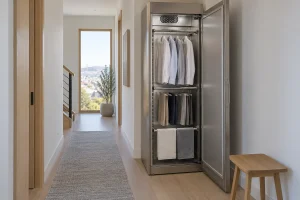
A drying cabinet is not a dryer. It is a tall closet where garments hang on rails while warm, dehumidified air passes over them, gently enough for wool, work jackets, ski gear and delicates. Asko lists it among its laundry products, and in San Francisco it tends to live in a mudroom, a garage-level utility room or a hallway cupboard in a flat with no outdoor line. Our Asko drying cabinet repair service treats it that way: the questions are about airflow, moisture removal and a water tray, not about a rotating drum.
The cabinet senses moisture and decides when to stop. If the sensor reads outside its range, the cycle can end early or run to its limit. On the listed models, E03 is described as a fault on the moisture sensor, with the sensor outside its measurement range, and E04 as the maximum drying time being exceeded. A full rail, a packed row of heavy coats and a blocked air path produce the second without any failed part. Asko drying cabinet not drying sorts those cases.
The heat pump version collects condensed water. E06 on the listed models means the water level in the tray is too high and the float switch has activated, and it carries the instruction to check the water pump. A tray that fills faster than it empties can come from a kinked outlet hose, a pump that is not moving water or a float that sticks. The machine is protecting the floor around it, so treat the code as useful rather than annoying.
E12 is a timeout in communication between the user interface and the electronics, described as temporary. A single power reset sometimes clears it. If it keeps coming back, the board or the connection needs to be checked.
The display on these cabinets reads either E03 or ERROR 03 in the same form. The meanings:
More background sits in Asko drying cabinet error codes.
A cabinet needs to breathe and to stand level. We look at the room before we look at the machine.
Two cabinets are in our records. The Asko DC7784V.W repair page covers an electric unit, currently sold. The Asko DC7784HP.W repair page covers the heat pump version. The two handle moisture differently, and so the codes about water, such as E06, belong to the heat pump family in the code list. We confirm which version you own at the start, using the label inside the cabinet door, which is usually where it sits.
We begin by watching a short program. Is air moving across the rails? Does warmth build? Does the display behave? Then we check the sensor and its reading, the fan, the heating or heat pump section and the water handling, in that order. The sensor gets particular attention because a failed reading and a failed dryer produce the same damp coat. We explain what we find in ordinary terms, write the estimate and wait for you to approve the work before any part is ordered.
Look at the display and note the code exactly. Empty the water container if your cabinet has one, and make sure any outlet hose is straight. Remove the clutter from the air inlet and outlet grilles, and leave the door gasket clean and closed. Space garments so air can pass between them. Check the plug, the breaker and the nearby outlet. A single controlled power reset, left off for a short pause, is the last thing to try.
Do not open the back, do not reach into the fan or heating compartment, and do not pour water into the base to test the float.
If the cabinet feels abnormally hot, makes a scraping sound, trips a breaker or leaves a puddle that keeps growing, switch it off at the breaker. If there is a smell of burning, do not restart it. Wet floors beneath a cabinet in a flat can reach the unit below sooner than you expect.
We work across San Francisco and the surrounding Bay Area, and plan around stairs and tight service corridors. To see how the cabinet fits in the broader lineup, go to Asko drying cabinets, or find your label with how to find your Asko model number.
A drying cabinet holds garments on rails and passes warm, dry air over them without tumbling. It suits woolens, jackets and sports gear. A dryer tumbles clothes in a drum.
E06 means the water level in the tray is too high and the float switch has activated. Empty the container if you have one, straighten the outlet hose, and try again. If it returns, the water pump needs checking.
The moisture sensor may be reading outside its range, which E03 describes, or the airflow may be blocked by a crowded rail or a shut closet door. Spacing the garments and opening the door can reveal which.
Yes. It needs open space for air, a level floor and a clear path for any water hose. Placement problems can mimic a failed part.
Yes. The label tells us which one you own, and the diagnosis follows from that.
Asko drying cabinets serviced in San Francisco: the electric and heat pump models, water tray alerts, E03 to E12 codes and the…
Diagnosis and repair for 24-inch built-in Asko dishwashers across San Francisco and the Bay Area, from drain faults and F-codes to leaks…
Vented and heat pump Asko dryer repair across San Francisco and the Bay Area: slow drying, filters, condensate trouble, door and sensor…
Asko induction cooktop repair across San Francisco: dead zones, pans not detected, shutdowns and unresponsive controls, with diagnosis first and your approval…
Asko wall oven and combi-steam oven repair across San Francisco: no heat, uneven baking, weak steam and door faults, with a written…
Share a few details and we’ll confirm an appointment. Prefer to talk? Call us and we’ll help right away.