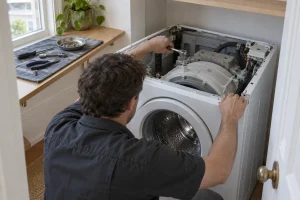
Washer Repair in San Francisco
Repair for Asko 24-inch front-load washers in San Francisco closets, nooks and stacked pairs: drain faults, door locks, shaking, leaks and E…
Compact front-loaders for closets and laundry nooks: find your model, decode the display and see when a visit makes sense.
An Asko front-loader is built to be small: 24 inches wide, quiet and often tucked into a hall closet beneath a matching dryer. That compact footprint is why San Francisco flats, condo laundry nooks and in-law units favor them, and it also shapes how problems show up. Here is what we repair, what the codes say and what you can look at yourself.
All the washers listed here are 24-inch front-loaders. The 5-series (Logic) is represented by the Asko W4114C.W.U repair page, the 3-series (Classic) by W2084.W.U, and the 3-series by Asko W3W.U repair and W3LW.U. The 7-series appears as W6098X.S/3. Two older machines, Asko W6461 repair and W6021, are no longer sold new. Browse the model pages when you need details on a specific unit.
The model label is usually around the door opening, visible once the door swings open. Photograph it before the visit. If it is hard to see in a closet, our short article on finding the Asko model number lists other places to look.
A washer that stops with water inside usually has a blocked drain pump filter, a pinched drain hose or a failing pump. See Asko washer not draining. The listed E7 code stands for a draining error, and E7.1 describes reduced flow in the pumping stage.
The lock engages by design and releases when the cycle allows it. When it does not, the display may show E22 (door closed but cannot be locked) or E23 (door closed but cannot be unlocked). Our article Asko washer door will not unlock explains what to try first.
If the drum fills but never spins, read Asko washer not spinning. Violent shaking connects to E13, listed as unevenly distributed laundry, and is covered in washer shaking and off balance. Excess suds map to E7.2, listed as too much detergent, and to our piece on too much foam.
Front-loaders hold moisture around the rubber gasket. Asko front-load washer smell lists the checks and when a visit is the better answer.
Our verified list includes these meanings among many others: E1 (thermistor error), E3 (water filling error), E6 (heating error), E9 (water leak detected in the appliance area), E11 (overflow), E12 (motor error), E26 (error while locking the door). Older units show F-numbers such as F1 (overflow), F2 (motor), F3 (drain pump), F4 (water inlet) and F8 (door opening fault). The complete index is on Asko washer error codes, with individual pages like E9 and E3.
Standpipe height and drain hose routing change how a washer drains, and a hose pushed too far down can siphon. In a stacked closet pair, the washer carries a dryer above it, so a level base and firm floor are essential. Supply hoses should run without kinks, and the gasket should seat cleanly around the door.
Look at power and the breaker, reseat nothing behind the panels, and confirm both water valves are open. Wipe the gasket, open the drain pump filter only if the owner manual describes it for your model and a towel is ready, and straighten any hose that has been bent. Write down the code and try one controlled power reset. Stop if the code returns, if water is on the floor, or if you smell burning. Switch the breaker off in that case.
Tell us the model, the code and what you already tried. We diagnose first, send a written estimate and repair nothing without your approval. Details on the process are on Asko washer repair.
The display style differs between lines. Current washers show E-numbers, while older ones use F-numbers such as F3 for the drain pump. The code page for your number gives the listed meaning.
Not necessarily. The lock holds the door shut while water or spin is active and releases afterward. If it stays shut with no water inside, note any door lock code such as E2, E22 or E23 and book a visit.
E13 is listed as unevenly distributed laundry. Redistribute the load, avoid washing a single heavy item alone, and check that the washer stands level.
Run what you like, but if either machine shakes or walks, stop it and level it first. Vibration in a stacked closet pair travels into both units and the wall.
Yes. Both are listed as no longer sold new, and each has a page of its own. Give us the model number and the symptom when you write.
Repair for Asko 24-inch front-load washers in San Francisco closets, nooks and stacked pairs: drain faults, door locks, shaking, leaks and E…
A guide to the 24-inch built-in Asko dishwashers we repair in San Francisco: models by series, common complaints, F-codes and safe checks…
Vented and heat pump Asko 24-inch dryers serviced across San Francisco: lineup, condensate and filter problems, E-codes and what you can safely…
Asko drying cabinets serviced in San Francisco: the electric and heat pump models, water tray alerts, E03 to E12 codes and the…
Asko induction cooktops in Bay Area kitchens: the two listed models, where the plate sits, common faults and the safe checks to…
Share a few details and we’ll confirm an appointment. Prefer to talk? Call us and we’ll help right away.