

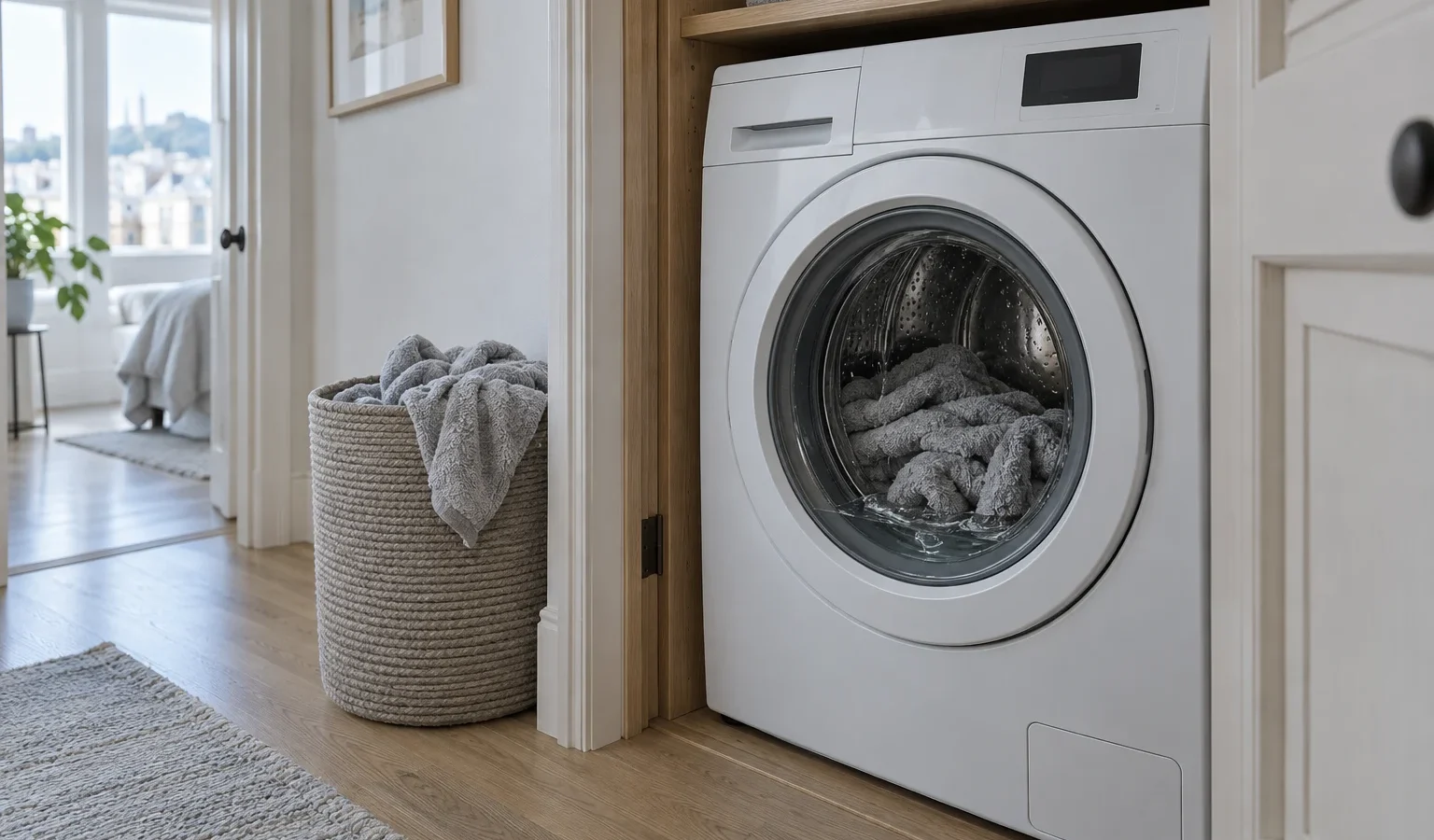
When an Asko front-load washer fills and drains but never reaches a spin, the cause is usually a load, a lock, a drain or a motor path. Here is how to tell which.
A front-load washer that fills, washes and then stalls before the final spin is giving you a clear clue: the machine decided, or was forced, not to accelerate the drum. Sometimes the decision is sensible, such as a protective pause for a lopsided load. Other times it points at a drain that never emptied, a door lock that did not confirm, or a drive problem. This article walks through those possibilities for an Asko washer in the order a technician would think about them.
Owners use the phrase for several different behaviors, and the difference matters. The drum may not turn at all during the cycle. It may tumble gently for washing but refuse the fast final spin. It may try to spin, hum, then stop and start the whole attempt again. Or it may finish the cycle with the clothes dripping and water still sitting in the drum. Each of these points toward a different part of the machine.
Front-load washers weigh the drum while it turns and will cut the spin short when laundry is bunched on one side. A single heavy towel, a bath mat or a duvet cover wrapped around a few small items can do it. Asko displays a code for this situation; the verified meaning of Asko washer E13 is unevenly distributed laundry. If you see it, stop the cycle, open the door once the lock releases, spread the wash out and add a similar item or two so the weight is shared, then run the spin again.
A very small load of a single bulky item is the classic offender. In a San Francisco flat where the washer sits in a hall closet and laundry is done in small batches, this happens often. Mixing a heavy piece with lighter ones usually cures it.
A washer will not accelerate the drum unless the door lock confirms the door is shut and secured. If a coat sleeve, a sock or the gasket fold keeps the door from closing fully, the cycle may wash but never spin. Look at the rubber seal around the opening for trapped cloth and push the door shut until it clicks. The library meanings help you read what the display says: E22 describes a door that is closed but cannot be locked, while E2 is a general door lock error. Those are lock-circuit faults, and repeating the cycle will not repair a latch that has failed.
If the tub still holds water at the point where the spin should begin, the controller waits or aborts. Check whether the drum contains water when the machine stops. If it does, treat it as a drain concern. The drain pump filter, a kinked outlet hose, or a hose pushed too far down a standpipe can all hold the water back. E7 is the draining error in the code library and F3 is a problem with the drain pump. Our separate article on Asko washer not draining covers that path in detail.
If the load is balanced, the door closes cleanly and the drum is empty of water, attention moves to the drive. The verified code meanings include E12, a motor error, and F2, a problem with the motor. A technician looks at the motor, its wiring and the control that commands it, and may also check whether the drum turns freely by hand with power removed, something that belongs to a professional visit rather than an owner task. A drum that scrapes, a bearing that groans or a noise before the failure are all details worth mentioning when you book.
If the same fault comes back after those steps, the cause is probably not something sitting on the surface.
Do not force the door open while the drum is moving or full of water, and do not pull panels off to look at the motor. Do not keep restarting the spin dozens of times; a drive fault that is retried repeatedly can heat parts that were only mildly damaged. If the washer smells of burning or you see sparks, switch it off at the breaker and leave it off.
Asko sells several washer platforms in the United States, and the spin hardware and the codes shown differ between them. Current 24-inch models on our list include the W4114C.W.U, a 5-series (Logic) washer, and the W3W.U from the 3-series. The label is usually found at the door opening. A photo of it, plus the code and what the drum did, lets the technician plan parts and the diagnosis before the visit.
We diagnose before repairing, give you a written estimate, and repair nothing without your approval. For a washer that will not spin, the diagnosis usually follows the same logic as above: load and lock first, then drain, then the drive path, with the code history guiding the order. Our Asko washer repair page describes the full visit, and the Asko washers guide lists the lineup we service across San Francisco and the Bay Area.
Stop the machine and leave it unplugged or switched off at the breaker if it hums loudly without turning, leaks, smells hot, or trips the breaker. Water left in the drum can be drained through the filter once the machine is off, but wet laundry will need to wait until the fault is fixed.
The controller only starts the fast spin when the door lock is confirmed, the drum has emptied and the load is balanced enough. A failure on any one of those three can leave you with a washed but dripping load.
Yes. A single heavy item bunches against one side of the drum and throws the weight off balance. Adding a few similar pieces and spreading them out usually allows the spin to start.
The code library lists E13 as unevenly distributed laundry. It is normally a load problem, not a failed part, though a washer that reports it on small balanced loads should be looked at.
Not necessarily a fault, because some washers hold the drum, but a drum that scrapes or feels locked deserves a technician. Do not open panels to find out why.
The model number from the door opening, the exact code on the display, what the drum did, and whether water was left inside.
Share a few details and we’ll confirm an appointment. Prefer to talk? Call us and we’ll help right away.