

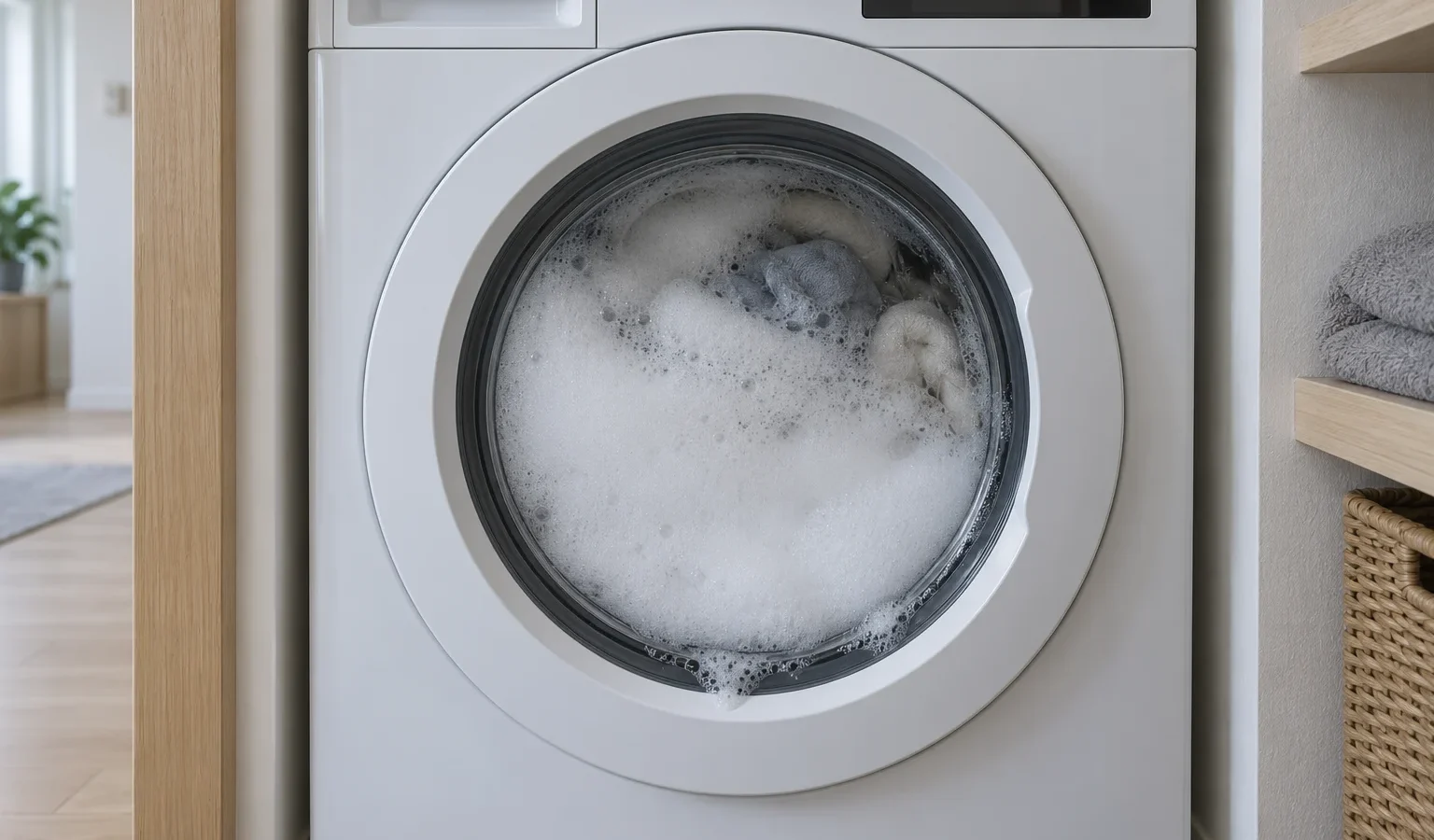
Suds pressing against the glass, foam in the drawer or a cycle that drags on can all trace back to detergent. Learn what to change and what needs a technician.
A front-load washer that fills with foam looks alarming, yet it is one of the more fixable complaints. Unlike a top-loader, a front-loader tumbles clothes through a small amount of water, so a little too much soap produces a lot of suds. The machine tries to protect itself by slowing down, adding rinse steps or stopping, and that can look like a breakdown. This article explains what is going on and how to tell a habit problem from a hardware one.
Asko washers watch how the drum behaves while it turns. When suds cushion the water, the sensors read something unusual and the controller reacts, extending the rinse or refusing to spin. The library meaning for E7.2 is an excessive amount of detergent, which is a direct way of saying that foam is the cause. Seeing that message is useful: it points you at the dose, not at a failed part.
Most people use too much, partly because older machines needed more water and more soap. Compact front-loaders use far less water, so the recommended dose is small. A few things push suds higher still:
Measure with the cap or scoop on the product, use less for a small or lightly soiled load, and give the dispenser a rinse.
Water that is naturally soft needs even less soap, and many Bay Area households have softer water than they expect. A half-empty drum has fewer clothes to scrub the soap away, so it foams more. If you notice suds on the glass at the end of the wash even though you used the recommended dose, try the next smaller measure and a larger load for the same amount of laundry.
Do not add vinegar, dish soap or an anti-foam product on your own. They can make residue worse or interact with other chemicals in the drum.
Suds are not always the cause; sometimes they are the effect. If the washer is draining poorly, soap that should have left with the water remains and keeps foaming. A blocked drain pump filter, a kinked hose or a standpipe that cannot take the flow can all do this. The related codes in the library include E7 for a draining error and E7.1, a drain system alert describing reduced water flow in the pumping stage. If the same foam appears even with a tiny dose and the washer is slow to empty, read our Asko washer not draining article and clear the filter if you can do so safely.
Suds that creep out of the detergent drawer or the front of the cabinet usually mean the dispenser is clogged or the water inlet is struggling to flush the compartments. Check the drawer for hardened detergent, rinse it under warm water, and confirm the water supply valves are fully open. A supply problem has its own codes in the library, such as E3, a water filling error, and a technician should examine anything involving the inlet valve and its screens.
Foam can travel where water would not, up the drain hose, behind the seal or onto the floor. If you find soap trails or a damp spot under the machine, stop using it. The library lists E9 as a water leak detected in the appliance area. That is not an owner repair, and it is worth a diagnostic visit.
Do not open the door while water or suds are visibly pressing against it, do not force the drawer, and do not remove panels to look for the source. If the washer sputters, smells hot or trips the breaker, switch it off at the breaker and leave it off. Foam can reach electrical parts if it overflows, and that needs a professional look.
If the dose has been corrected and the suds still return, or if you see a leak or an overflow code, the next step is diagnosis. We examine the machine before repairing, give you a written estimate, and fix nothing without your approval. Read about the process on the Asko washer repair page and see the Asko washers guide for the lineup. A model label at the door opening helps; two current 24-inch examples on our list are the W3LW.U and the W4114C.W.U. Mention the detergent brand type you use and how much you add.
Usually, but not always. A weak drain, a clogged dispenser or a very small load can also keep suds in the drum even when the dose is reasonable.
The code library lists it as an excessive amount of detergent. Reduce the dose, use a detergent for front-loaders and run a rinse program.
No. Those products can add residue or react with what is already in the drum. Rinse programs and a smaller dose are the safer route.
The drawer may be clogged or the flushing water may be weak. Clean the drawer, check that the supply valves are open and book a visit if it continues.
If suds return with a tiny dose, the washer drains slowly, there is any leak, or the display shows a water-related code that does not clear.
Share a few details and we’ll confirm an appointment. Prefer to talk? Call us and we’ll help right away.