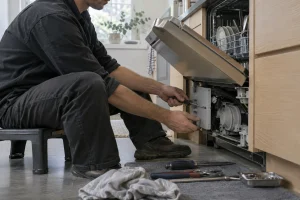
Dishwasher Repair in San Francisco
Diagnosis and repair for 24-inch built-in Asko dishwashers across San Francisco and the Bay Area, from drain faults and F-codes to leaks…
From 30 Series to 60 Series, here is how to recognize your Asko dishwasher, read its code and decide on the next step.
Asko dishwashers are narrow, quiet European machines, and in San Francisco they usually sit in a remodeled Victorian kitchen, a condo galley or an in-law unit where every inch of cabinet width counts. This guide covers the 24-inch built-in dishwashers we work on, the complaints that bring owners to us, the display codes that matter, and what you can safely look at before a visit.
Every dishwasher listed below is a 24-inch model, apart from two units whose width is not recorded in our library. The 40 Series includes the Asko DBI564 repair, DFI564 and DBI364 pages. The 30 Series is represented by DBI563 and DFI563, the 50 Series by DBI565 and DFI565, and the 60 Series by DBI776 and DFI776. Several machines carry no series name in our records: DFI663 (current), DBI664, DBI675, DFI675, DBI786 and DFI786 (availability unknown), and DFI664, which is no longer sold new. DOD561 and DSD565 round out the list.
Each has its own model page, such as the Asko DFI663 repair page and the Asko DBI776 repair page.
On most built-in dishwashers the data label sits on the door edge or on the inner tub rim, visible when the door is open. If your unit is fully integrated behind a cabinet panel, open the door all the way and look along the edge. Our article on how to find your Asko model number walks through the other usual spots.
Standing water after a cycle is the most common call. The cause can be as simple as a clogged filter or a drain hose kinked behind the machine, or it can be a failed drain pump. Read Asko dishwasher not draining for the order of checks.
A dishwasher that starts and then stops with a dry tub points at the inlet side: the supply valve under the sink, a pinched supply line or the inlet valve itself. The opposite problem, too much water, is handled by the level controls, which is why the overfilling codes exist. See Asko dishwasher not filling with water and Asko dishwasher leaking water.
Damp loads suggest a heating or drying issue, and a machine that ignores the Start button points at the door latch, the controls or a stored fault. Our troubleshooting articles on dishes that are not drying and a dishwasher that will not start cover both. Grinding or humming is covered in Asko dishwasher loud noise.
Asko dishwashers show F-numbers. The meanings below come from our verified code list, and each code has its own page.
The full list is gathered in Asko dishwasher error codes.
Confirm the dishwasher has power, the breaker is on and the door closes firmly against its gasket. Clean the filter in the tub floor, clear any debris from the drain screen and make sure neither the drain hose nor the supply hose is kinked where it runs through the cabinet. Check that the water supply valve is open. Then read the code, write it down, and try one controlled power reset by switching the breaker off and on. If the same code returns, stop there.
Do not remove the lower panel or run the unit repeatedly with a fault showing. If you see water on the floor, smell something burning or notice sparks, switch the breaker off and keep the machine idle.
A technician starts with the model number and the code, then checks the drain path, the inlet and the pump before touching anything else. You receive a written estimate, and nothing is repaired until you approve it. For details on the work itself, see Asko dishwasher repair.
It is usually on the door edge or along the inner tub rim, and you can read it with the door open. Write it down together with the code on the display, because the pair tells a technician which controls and which parts you have.
Some jobs are done with the door open and the lower panel off, and others need the unit slid forward from a tight 24-inch cutout. The diagnosis says which, and you approve the work before anything is taken apart.
F11 is listed as a water outlet fault. You can look for a kinked drain hose and a blocked filter or drain screen, but opening the machine is for the technician.
Both codes are listed as overfilling. Switch the dishwasher off at the breaker, close the water supply valve and keep the unit idle until it has been diagnosed.
We diagnose the 24-inch Asko dishwashers in the lineup above and on the related model pages, including units that are no longer sold new. Send the model number with your request so the visit starts with the right information.
Diagnosis and repair for 24-inch built-in Asko dishwashers across San Francisco and the Bay Area, from drain faults and F-codes to leaks…
Vented and heat pump Asko 24-inch dryers serviced across San Francisco: lineup, condensate and filter problems, E-codes and what you can safely…
Asko drying cabinets serviced in San Francisco: the electric and heat pump models, water tray alerts, E03 to E12 codes and the…
Asko induction cooktops in Bay Area kitchens: the two listed models, where the plate sits, common faults and the safe checks to…
Asko wall ovens and combi-steam ovens in Bay Area kitchens: the listed model, where the label sits, common faults and safe owner…
Share a few details and we’ll confirm an appointment. Prefer to talk? Call us and we’ll help right away.