

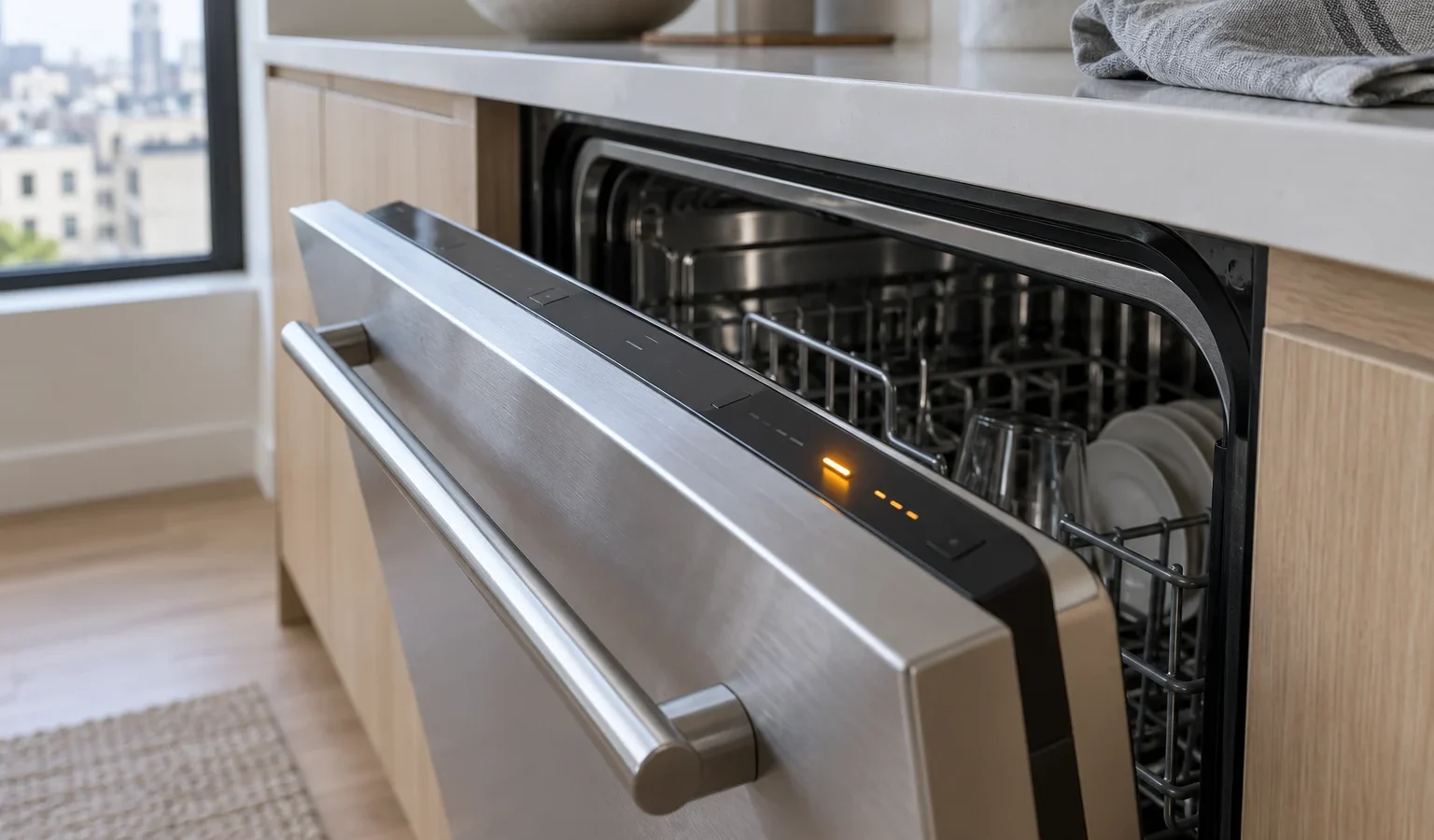
A guide to the F-numbers that Asko dishwashers display, grouped by what they involve: water in, water out, heating, circulation and the diverter, with links to each code.
Asko dishwashers report faults as F-numbers. The code appears when the control notices something outside its expected range: too much water, too little, no drain, a heater that does not respond, a pump that does not turn. The number does not say which part is broken. It says which system the machine is worried about, and that is a very useful head start for anyone diagnosing it.
Note exactly what the display shows, including whether the code flashes and whether the cycle stopped. If the dishwasher offers a way to cancel the program, use it once. Then do a single controlled power reset: switch it off at the breaker, wait a short while, switch it on and see whether the code returns. A code that disappears and does not come back may have been a one-off. A code that returns right away is real. Do not keep cycling power, because each try can add water or stress the pump.
Four codes in our reference concern the fill side. F12 is a water inlet fault and F67 is a second water inlet fault on the DBI564 series. F40 reports inlet valve leakage, which suggests water is entering when it should not. The owner checks are modest: confirm the supply valve under the sink is open and the supply hose is not bent. Anything inside the machine is for a technician. The article on an Asko dishwasher not filling with water walks through the symptom side.
F10 means overfilling (water 1) and F54 means overfilling (water 2). Two separate codes suggest two layers of protection, so when either shows, treat it as a reason to stop the machine, close the supply valve and watch for water at the door. F52 is a water level fault, which can sit alongside either one. If you see water on the floor, switch off at the breaker and turn off the supply at the valve.
F11 is a water outlet fault (drain) and F68 is a BLDC drain pump fault, the latter listed for the DBI564 series. With either one, expect standing water and a stopped cycle. Clean the filter and check the visible drain hose, then see our article on a dishwasher that is not draining.
These three are not owner repairs. They involve live circuits, rotating parts and water paths behind the tub. The honest owner action is to record the code, stop using the machine if the symptom is obvious, and book a diagnosis.
Our library ties these codes to the DBI564 series and the DBI664 XXL, and some entries apply to the DBI564 series only. That does not mean other Asko dishwashers cannot show similar faults, only that the meanings above are verified for those families. A DBI564 owner can use the full list. For a DFI663 or another family, the technician confirms the meaning at the machine. The model number is usually on the door edge or the inner tub rim, so find it before you call. Our guide to finding the Asko model number shows where to look.
Several codes are triggered by the installation rather than a failed part. A drain hose without a high loop, a disposer inlet that was never opened, a supply valve that is half closed, or a hose pinched behind the machine in a narrow Victorian-flat cutout can all trip a water code. The control only reports the symptom. This is why diagnosis comes before parts: swapping a pump to cure a pinched hose is an expensive mistake that we try to avoid.
Stop using the machine and switch it off at the breaker if any code comes with water on the floor, a burning smell, sparks or a hot door. Book a visit if a code returns after the reset. We diagnose, write up an estimate and do nothing without your approval. The Asko dishwasher repair page covers the process, and the Asko dishwashers guide has the lineup.
A short note makes a diagnosis quicker. Record the code, the program that was running, how far into the cycle it stopped, whether there was water in the tub, and any sound you heard just before the fault such as humming, grinding or clicking. Add what changed recently: a new disposer, a plumbing job, a countertop replacement, a power cut, or a move of the machine. Faults often follow one of those events. A photo of the display and of the label on the door edge or tub rim saves a second trip for parts, because the correct model is known before anyone arrives.
If the display shows two codes in succession, record both in the order shown. The first is usually the cause and the second a consequence, though a technician decides that at the machine.
It shows on the control display when a fault occurs. Write it down before cutting power, because a reset may clear the screen.
Yes. Switch off at the breaker, wait, then switch on. Repeated resets are not helpful and can add water to the tub.
If the code does not return and nothing leaks, you can keep using it while you watch. A code that comes back means the fault is still present.
Meanings can vary between families. The list here is verified for the DBI564 series and the DBI664 XXL, so confirm the code at the machine for anything else.
The technician reads the code, checks the hose route and connections, tests the suspect part and gives you a written estimate before repairing anything.
Share a few details and we’ll confirm an appointment. Prefer to talk? Call us and we’ll help right away.