

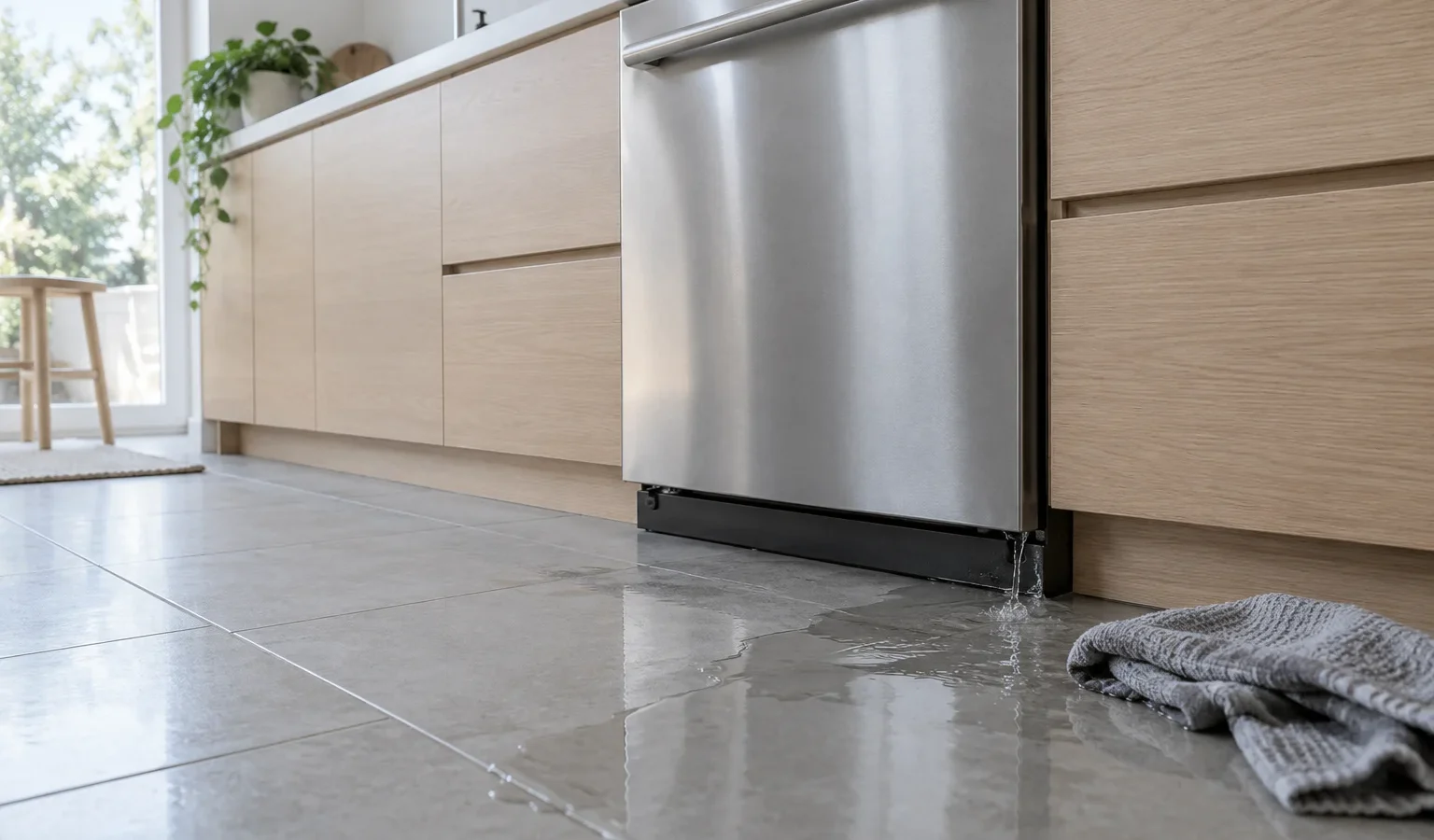
Water on the kitchen floor near an Asko dishwasher can come from the door, the supply connection, the drain hose or an internal fault. Learn what to check and what to leave alone.
A wet patch in front of the dishwasher, a swollen toe-kick or a musty smell inside the sink cabinet all say the same thing: water is leaving the machine’s plumbing path. In a multi-story building, including condos and split-up Victorians, the damage can reach the unit below before you notice, so act on the first sign rather than waiting to see if it repeats.
Turn off the dishwasher at its breaker. Close the small supply valve under the sink if you can reach it. Mop the floor so you can see where fresh water appears. If the leak is large, the machine will be heavy with water, so do not try to slide it out alone. Take photos of the wet area before you wipe it; they help show where the water traveled. If you smell burning or see scorch marks near a puddle, leave the breaker off and call.
Watch when water appears. A puddle that grows during the fill suggests the supply side. A puddle that appears when the machine empties suggests the drain hose or its connection. Water only at the door while the wash arms spray points to the gasket or to oversudsing. A constant slow leak while the machine is idle points to the inlet valve, and our reference lists F40 as inlet valve leakage for the DBI564 series and DBI664 XXL. A tub that fills too far can also spill; the codes F10 and F54 report overfilling in two stages, and F52 reports a water level fault.
That is where owner work ends. Tightening fittings behind the panel or opening the base of the machine is not a safe homeowner job.
A European-size 24-inch dishwasher slides into a snug cutout, so the hoses live in a tight space with little room to relax. A drain hose bent over a sharp edge may crack with age. A machine that is out of level lets water collect at one end of the door seal. In remodeled kitchens, a countertop brace that presses down on the top of the unit can distort the door line, and a hose clamp left finger-tight after a disposer swap can weep for months. A technician checks each connection, the levelling feet, the door alignment and the cutout in a single visit.
Book as soon as you have stopped the water and cannot trace a simple cause such as a loose drain clamp or a gasket full of debris. A recurring puddle after you have cleaned the gasket and filter needs a diagnosis. We diagnose before any repair, give a written estimate and wait for your approval. If the leak has already reached a neighbor’s unit or a hardwood floor, tell the building manager and consider a plumber for the building side. Our Asko dishwasher repair page explains the process, and you can compare the lineup in the Asko dishwashers guide. Families such as the DBI564 and DFI564 are listed there.
A slow leak rarely announces itself. The water runs behind the toe-kick, soaks the particleboard under the sink base and spreads into the flooring before any puddle shows. Look for a softened cabinet floor, lifting laminate near the dishwasher, a stain on the ceiling of the unit below, or a smell of damp wood. Press a fingertip on the cabinet floor under the sink: if it feels spongy or looks dark, the leak has been going on for a while. Mention that when you call, because it changes how the technician approaches the visit and whether the building plumbing should be checked as well.
It is better not to. Small leaks can soak the cabinet base and cause damage that is more expensive than the repair. Switch it off until the source is known.
Often it is detergent. Excess suds push out around the door. Reduce the amount, confirm the product is made for dishwashers, and run a rinse. If water still escapes, book a check.
Supply water is clear and stays dripping when the machine is idle with the valve open. Drain water is grey or cloudy and shows up when the machine empties.
Not usually. Many leaks come from a hose, gasket or connection. The diagnosis shows whether the cause is a simple part or something bigger.
Yes. We diagnose first, provide a written estimate, and carry out nothing until you say yes.
Share a few details and we’ll confirm an appointment. Prefer to talk? Call us and we’ll help right away.