

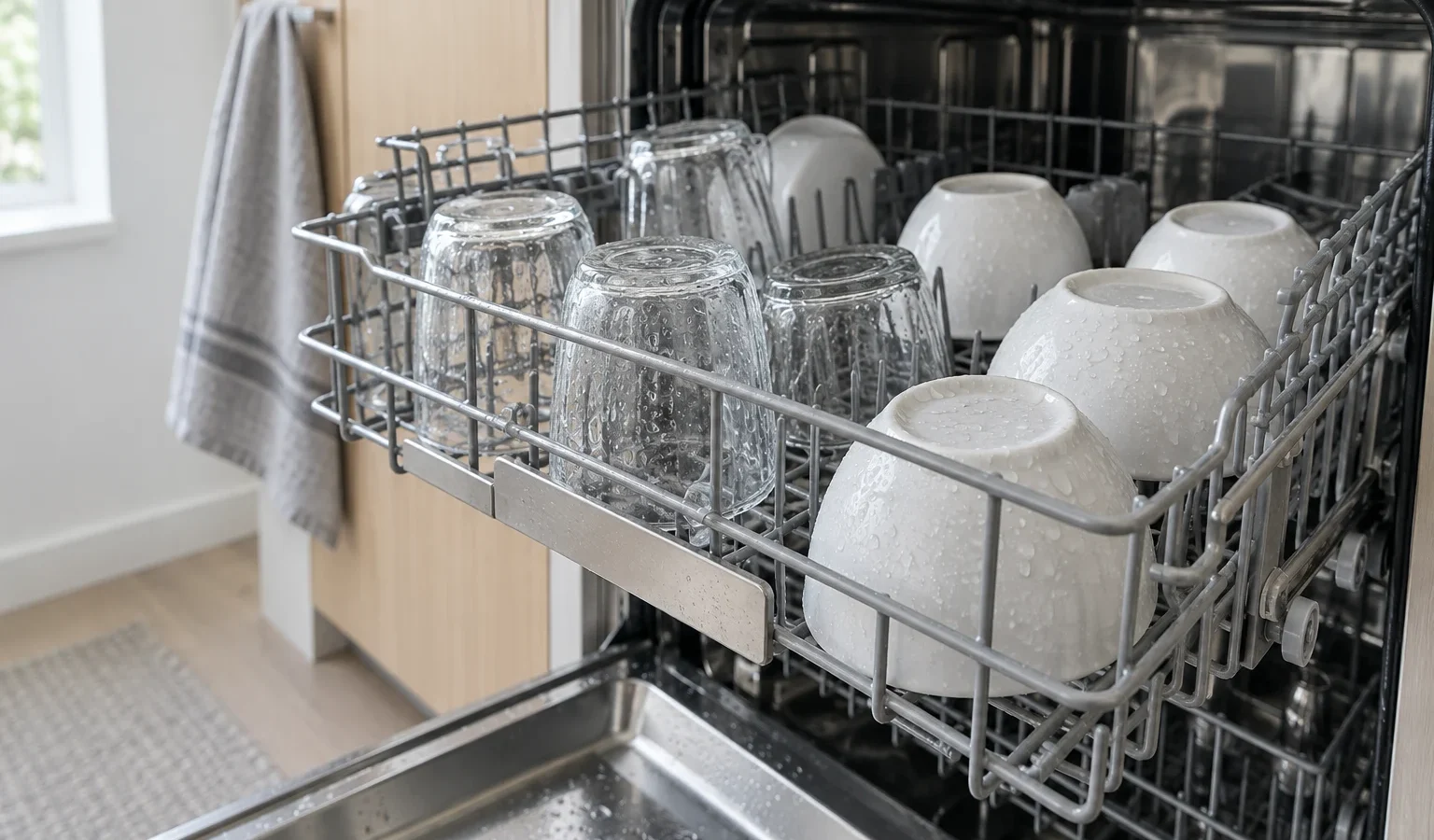
Damp plates and pooled water on cups after the cycle can come from rinse aid, loading, the door seal or a heating fault. A practical guide for Asko owners in the Bay Area.
A dishwasher that cleans well but leaves everything damp is easy to live with for a week and irritating by the third. Before assuming the machine is broken, it helps to know how drying actually happens. Hot final-rinse water warms the dishes, the water evaporates, and the moisture has to go somewhere, usually by condensing on a cooler surface inside the tub or leaving through a vent path. Weaken any step and the load stays wet.
The pattern is the first clue. If only plastic containers and the tops of cups are wet, the machine may be working normally, because plastic holds less heat and dishes that face upward collect pools of water in their dips. If everything is wet, including steel and glass, the final rinse may not be getting hot enough or the cycle may be ending before it dries. If the dishes are wet and the bottom of the tub still holds water, you are looking at a drain complaint rather than a drying one, and our guide to an Asko dishwasher that is not draining is the better place to begin.
If every item stays wet even after a trial with good loading and rinse aid, a technician looks at the parts that create heat and control water. Our reference lists F41 as a heater fault on the DBI564 series, and a heater that no longer warms the final rinse would fit the symptom exactly. A water level fault (F52) can also shorten or alter the program. Machines without a code can still have a weak heating element, a failing temperature sensor, or a door seal that no longer closes evenly. None of these are owner repairs, because they involve live circuits and sealed spaces behind the tub.
Where a dishwasher sits changes how well it dries. In a tight 24-inch cutout under a stone countertop, hot steam can be trapped against the underside of the counter and condense into drips instead of leaving by the intended path. A cabinet panel fitted too close to the door, a rolled-up gasket after a countertop fitting job, or an unlevel machine that tilts water into one corner of the tub can all make results worse. In Bay Area remodels of older flats the cutout is often rebuilt around the dishwasher, so a small error in height or levelness shows up as a damp-dish complaint months later.
Book when the damp-dish result stays after the rinse aid, loading and program checks, when a heater or level code appears, or when you notice a scorched or electrical smell. If you smell burning, switch the dishwasher off at the breaker immediately. We diagnose first, give a written estimate and wait for your approval. Our Asko dishwasher repair page describes the visit, and the Asko dishwashers overview shows which families we work on, including the 30 Series DBI563 and the 60 Series DBI776.
Run one cycle with nothing in the tub except a few steel and glass items spaced well apart, with rinse aid in place and the longest regular program selected. If those pieces come out dry and only the awkward shapes stay wet in a full load, the machine is fine and the loading is the difference. If even steel and glass are wet, the final rinse or the end of the program is falling short, and that is worth a technician’s time. Keep notes on which program you chose and how long the cycle took, because that detail speeds up the diagnosis.
It is also worth listening for the end of the cycle. A heated drying stage usually runs quietly for a while after the last drain. If the machine finishes abruptly right after the final drain and the interior is cold to the touch, the heating stage is probably not happening at all.
Plastic stores less heat than glass or steel, so water on it evaporates more slowly. Some dampness on plastic is expected even in a healthy machine; a towel finish is common.
Yes. It lowers the water’s tendency to bead on surfaces, so a thin film runs off or evaporates quickly. An empty dispenser is one of the most frequent reasons for a damp load.
It can. If the final rinse is not heated, the dishes stay cool and wet. A heater fault code, or a machine that never feels warm inside after a cycle, points that way.
If there is no burning smell, no leak and no code that stops the cycle, it is generally safe to keep using while you arrange a visit. Switch it off at the breaker if anything smells hot.
The technician diagnoses first and writes up an estimate. Nothing is repaired until you approve it.
Share a few details and we’ll confirm an appointment. Prefer to talk? Call us and we’ll help right away.