

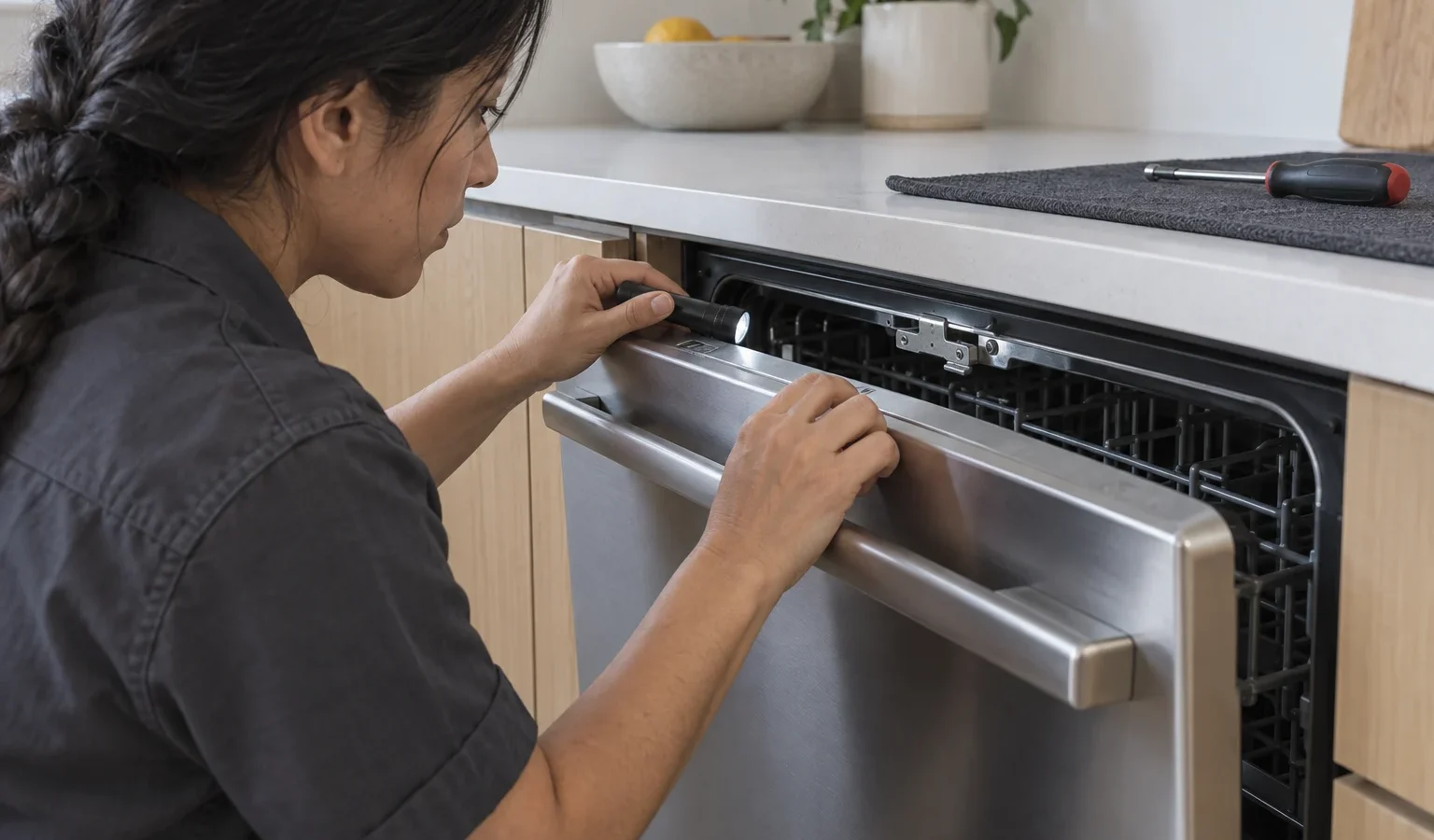
When an Asko dishwasher shows no response or refuses to begin a cycle, the cause is often power, the door latch or a lock setting before it is a failed control.
You load the machine, select a program, press start and nothing follows. Perhaps the panel is completely dark, perhaps it lights up and ignores the button, or perhaps it clicks once and stops. A dishwasher needs four things to start: power, a closed and latched door, a valid program request and no fault stored by the control. Work through them in that order and most no-start complaints sort themselves out.
Describe the behavior precisely, because it points to the cause. A completely dead display suggests a power problem, either at the breaker, the GFCI protecting the kitchen circuit or the power connection. A display that lights but does not begin suggests the door switch, a child lock or a held setting. A cycle that starts and stops in a few seconds suggests a fault the control found as soon as it tried, for example a water level problem. A program that begins but stays on the first step suggests that the machine is waiting for something, such as water.
A code on a dishwasher that will not start usually names the system that stopped it. F12 (water inlet fault) or F67 can stop a program before it moves on, and F52 (water level fault) or F10 (overfilling) can block a restart until the water issue is cleared. Our guide to the full set of Asko dishwasher error codes shows how to read them, and the water-side articles on a dishwasher not filling with water or not draining cover what follows.
A 24-inch dishwasher is usually connected by a short power cord to a dedicated outlet or a junction box in the sink cabinet. After a disposer swap, a countertop job or a floor replacement, the cord may be stretched or the plug partly out of its socket. Cabinet fronts fitted too close to the door can leave the latch just short of engaging. In older flats, a shared kitchen circuit that also serves the disposer and the countertop outlets can trip when two loads start together, and a GFCI placed elsewhere in the room may be the real culprit. A technician checks the supply, the latch and the cutout together.
A burning smell, a popping sound or any visible sparking means you leave the breaker off and call for service. Those are signs of an electrical fault in the machine or its connection, not of a setting issue.
Book when the breaker and GFCI are fine, the door closes properly, the control lock is off and the machine still does nothing; when it trips the breaker; or when it starts only after repeated attempts. The technician tests the door switch, the supply and the control in the right order, giving a written estimate before any repair and waiting for your approval. Most current families, including the 40 Series DBI364, are in our library. Read about the visit on the Asko dishwasher repair page, and see the Asko dishwashers overview.
A machine that has always been slow to start differs from one that stopped working this morning. Think back to what happened last: a power cut in the neighborhood, a surge when the flat’s heating came on, a disposer repair, a rinse cycle that was interrupted, or a drawer of cutlery shoved in too hard against the door. A utility outage can leave the control holding a stale state that a single reset clears, while a plumbing job can leave the door misaligned. Tell the technician the sequence of events. It saves time, because the first tests are chosen to fit the story rather than run in a fixed order.
Some dishwashers include a delayed start, and a countdown might be running while the machine appears idle. Others hold the door lock indicator until the child lock is released. An energy-saving mode may dim the display after a period and need a button press to wake. Before you decide the control is broken, press each of the visible buttons once and read the screen. A program that seems missing may have simply been replaced by a delay setting that you pressed on the way past.
Check the breaker and any kitchen GFCI first. If power is present at the circuit and the panel stays dark, the machine’s connection or control needs testing.
The door may not be latched, a control lock may be on, or the program may need to be confirmed. Close the door firmly and check for a lock indicator.
Yes. Kitchen GFCI outlets sometimes protect other outlets and circuits, so a tripped one can cut power to a machine plugged somewhere else.
Pressing is harmless, but repeated breaker resets are not helpful. If the breaker trips, leave it off and call.
The technician explains the process at the visit. The key point is that nothing is repaired without your approval.
Share a few details and we’ll confirm an appointment. Prefer to talk? Call us and we’ll help right away.