

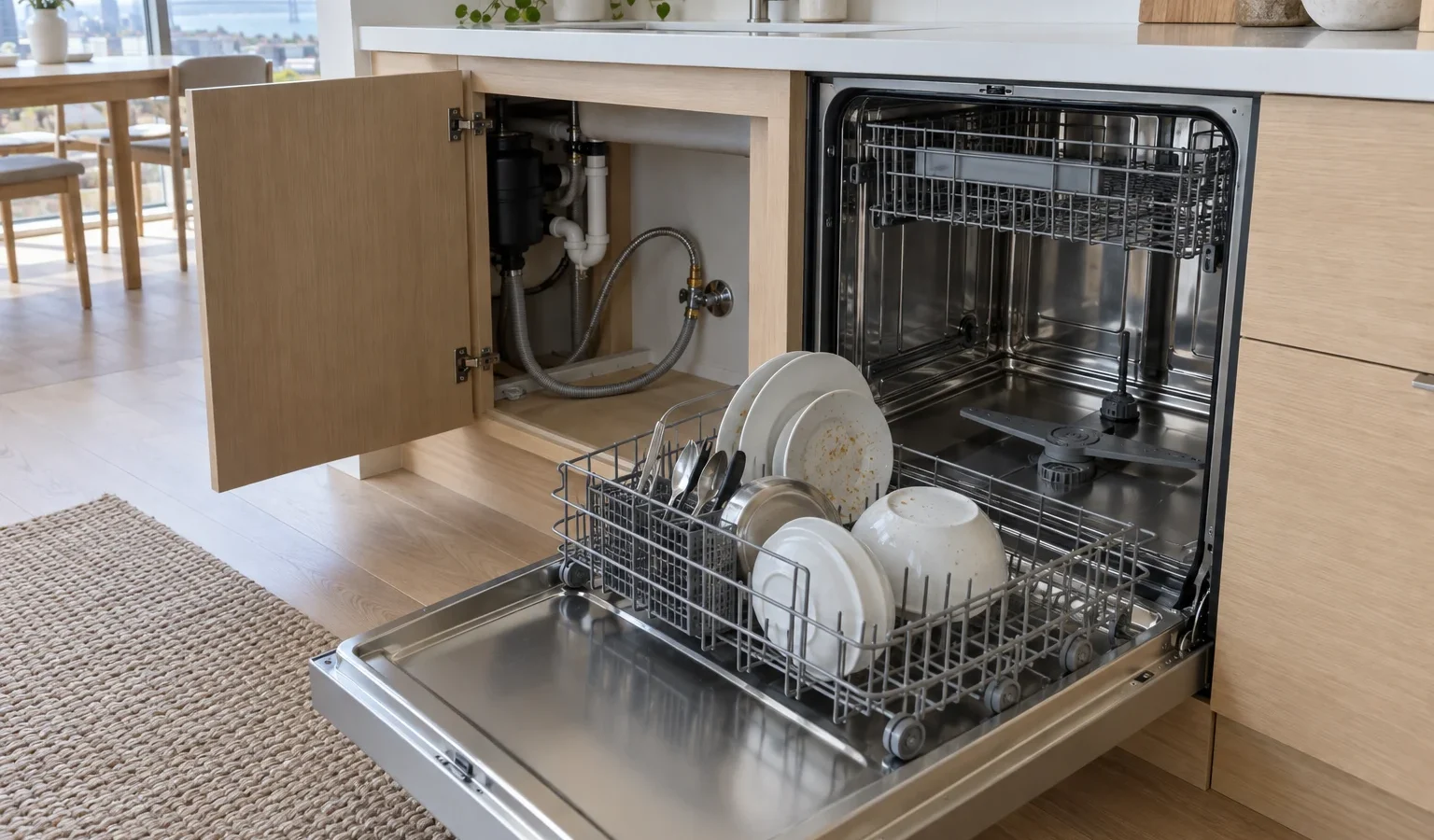
When an Asko dishwasher starts but sprays little or no water, the trouble may be the shut-off valve, a bent supply hose, the inlet valve or a sensing fault.
You hear the motor, the program runs and the display counts down, yet the dishes come out dusty with dried-on food. Lift the door mid-cycle and the tub is nearly empty. The dishwasher is not receiving enough water, or it is receiving it and the control cannot confirm that it did. Both are common, and the fix ranges from turning a small valve handle to replacing a part.
Water takes a fixed route into the machine. It leaves the house supply at a small shut-off valve, usually under the kitchen sink, travels along a supply hose, passes through an inlet valve on the dishwasher, and then enters the tub. Any link in that chain can restrict it. A valve left partly closed after plumbing work, a hose crushed when the dishwasher was pushed back into its cutout, a clogged inlet screen or a failed inlet valve all give the same symptom of a short or empty fill.
For the DBI564 series, our reference lists F12 as a water inlet fault and F67 as a second water inlet fault. For the same family, F40 is inlet valve leakage, which is the opposite problem: water getting past a valve that should be closed. A water level fault (F52) means the control cannot make sense of the level it sees. That might be a sensing problem, not a missing supply, so it takes testing to tell them apart. The overview of Asko dishwasher error codes places each of these within the full set.
Bay Area kitchens in older buildings often have compression stops that are decades old, copper stubs that accumulate mineral scale, and narrow cutouts that leave little space behind a 24-inch dishwasher. A supply line pinched behind a stone countertop or a hard-water scale buildup inside the valve screen restricts the flow without producing any leak or visible fault. If the dishwasher was recently moved for a floor or counter job, the supply hose is the first thing a technician looks at. Where a disposer, an air gap and a new drain loop were all added in the same remodel, the connections are checked together.
Book if the supply valve is open, the hose is clear, the tap runs normally and the dishwasher still fills poorly, or if a code such as F12 or F67 returns after the reset. Book at once if you find water pooling under the machine, because F40-type leakage can keep adding water even when the dishwasher is idle. Close the supply valve and switch off at the breaker first. We diagnose before repairing, give a written estimate and wait for your approval. The technician will confirm the model number, found on the door edge or inner tub rim, and test the inlet valve and sensing. Families such as the DBI563 and DFI563 are in our library.
The Asko dishwasher repair page explains how the visit runs, and the Asko dishwashers guide describes the lineup. If water is not leaving rather than not arriving, read about the leaking dishwasher as well, since a leak can start at the same inlet connection.
A failing inlet valve leaves a few recognizable traces. The machine may fill on some cycles and not on others, a faint hiss may continue after the machine is idle, or a damp patch may appear under the front edge though the door seals look fine. Mineral buildup from hard water can make the valve sluggish before it fails outright, and a small piece of scale in the inlet screen can block the flow when the washer is first started. A technician tests the valve rather than assuming it, because the supply, the sensing and the control can all mimic the same behavior.
If you notice the symptom only after a plumber or a renovation crew worked nearby, mention it. Disturbed pipes release debris that settles in screens, and that is a cleaning job rather than a part replacement.
If too little water reaches the spray arms, the wash is weak. The usual causes are a partly closed supply valve, a bent hose or a failing inlet valve.
Yes. If the kitchen tap also runs weakly, the problem sits in the building. If the tap is strong, the restriction is more likely in the hose or the dishwasher’s inlet valve.
Not necessarily. F12 reports a water inlet fault. A closed valve or kinked hose can trigger it, so those are checked before any part is replaced.
Running dry stresses the wash pump and spray system, so stop the program and book a diagnosis rather than repeating cycles.
It helps. Note it from the door edge or inner tub rim when you request the visit.
Share a few details and we’ll confirm an appointment. Prefer to talk? Call us and we’ll help right away.