

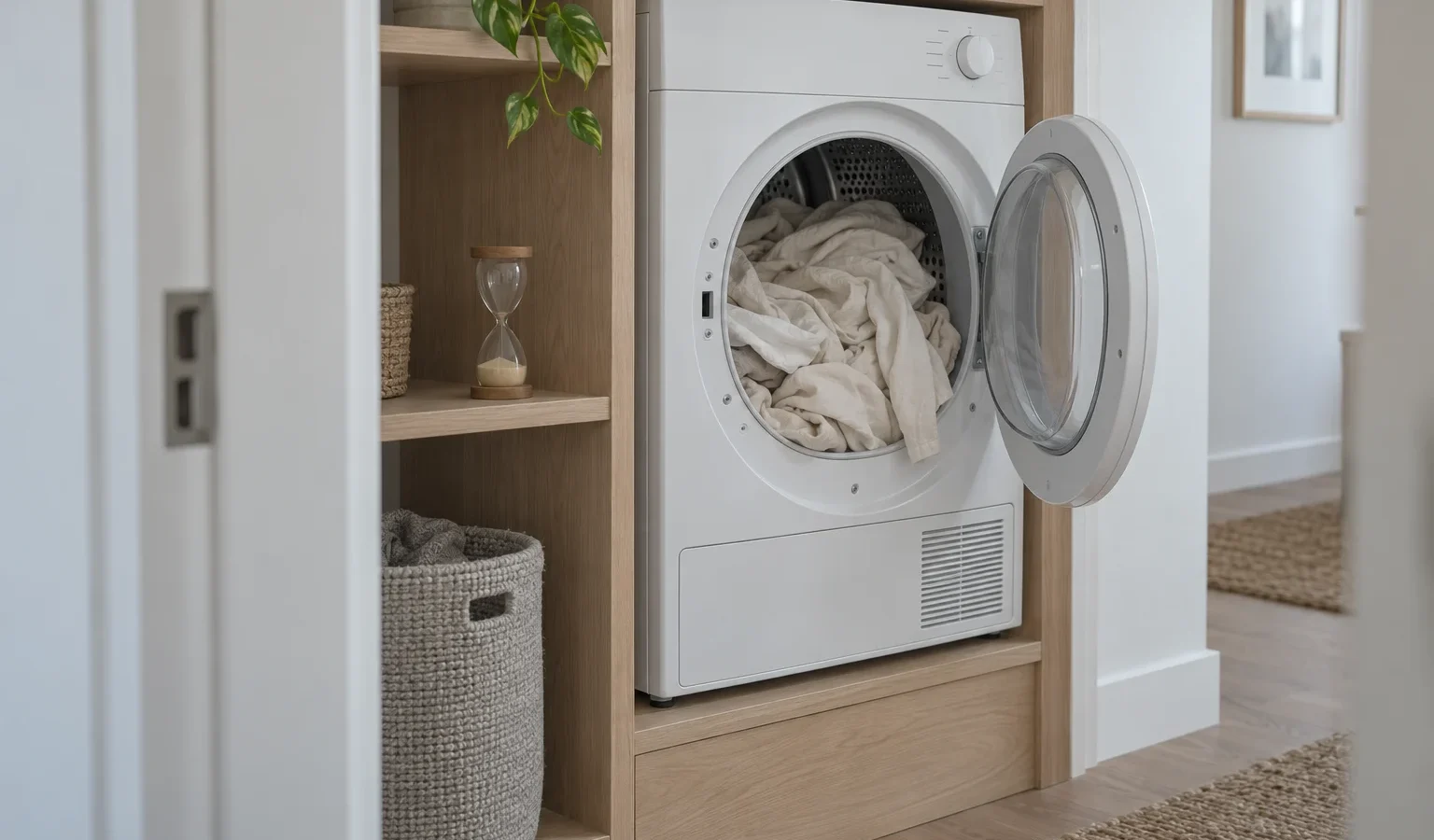
When a cycle that used to finish quickly now needs a second run, the cause is usually airflow, load, a wet start or a sensor. Work through these checks.
Slow drying is the most common dryer complaint, and the cause is rarely a single dramatic failure. More often a handful of small restrictions add up: some lint, a heavier load, a wetter wash, a room that is too warm. A heat pump dryer also runs longer by design than a vented dryer, so the question is not “why is it slow?” but “why is it slower than it used to be?” That change in baseline is the clue to hunt down.
Before touching anything, note how long a typical towel load takes now compared with a month ago. Check whether the laundry is warm or cool at the end, and whether the machine feels hot on the outside. Those details point in different directions.
Lint on the door filter, a film on the screen, or a coated condenser filter on a heat pump dryer reduces airflow. Clean them first. The full story is in Asko dryer filters clogged, but the short version is to rinse the screen, dry it, and follow the manual for the condenser filter. On a vented dryer, make sure the outside hood flap swings freely and the duct is not crushed behind the machine.
A weak spin in the washer sends in clothes that carry a lot of water, and the dryer has to evaporate every bit of it. If the washer has been leaving laundry soggy, the dryer will look slow even if it is fine. Check the washer’s spin, balance and drain; our Asko washer not spinning article walks through those causes. In stacked pairs, a washer problem often appears as a dryer problem first.
Try a moderate load of one fabric type on a standard cotton program. If that works, your habit was the cause.
A heat pump dryer that cannot dispose of its condensate slows or stops. A full container or a kinked drain hose is a frequent cause; the code library lists E3 as a pump error, a condensate pump failure. The companion article on the Asko dryer condensate water problem explains those checks, and another piece covers a heat pump dryer not drying at all.
A heat pump dryer releases warmth into the room it sits in, and a small closet with the door closed holds that heat. The same goes for a vented dryer pulling air from a sealed room. Leave the closet door ajar and make sure the front has space. San Francisco condos that tuck laundry into a hall closet often need the door open during a cycle.
If the dryer misjudges dryness or temperature, it can end early or run on. Relevant library entries include E1, a thermistor error, and E4, a control unit failure for which the manual advises cleaning the filters. These are not owner repairs beyond the filter. A technician can test a sensor, a heating or heat pump component and the control without guesswork.
Bay Area households often notice slower drying when the weather turns damp, because the room air is already humid, and a vented dryer is drawing that air in. Households with growing families also push loads upward without noticing. Look at the pattern: if the slowdown arrived together with new bedding, a new washer setting or a change in how often you dry thick items, the dryer may simply be doing more work than before. Adjust one thing at a time so the result is easy to read.
Do not extend drying by running the same load several times without finding the cause, since each run strains the machine. Do not remove panels to check the heater or heat pump. Do not use the dryer if it smells burnt; switch off at the breaker and leave it off.
If you have cleaned the filters, balanced the load, checked the washer and emptied the water, and the dryer remains slow, book a visit. We diagnose before repairing, provide a written estimate and repair nothing without your approval. Read the Asko dryer repair page and the Asko dryers guide for details. Bring the model number from the door opening; an example is the T3HW.U, a 3-series heat pump dryer. Tell us how cycle length has changed.
It depends on the program and load, and it runs longer than a vented dryer by design. What matters is a clear increase over your own normal.
Yes. A weak spin leaves laundry heavy with water, and the dryer needs far longer to finish it.
Not if it is too full. Clothes need room to tumble so air can move through them.
Heat without airflow or moisture removal. Filters, the vent hood or the condensate path may be restricted.
After filters, load, washer spin and water container are checked, or sooner if the dryer smells hot, shows a sensor code or trips the breaker.
Share a few details and we’ll confirm an appointment. Prefer to talk? Call us and we’ll help right away.