

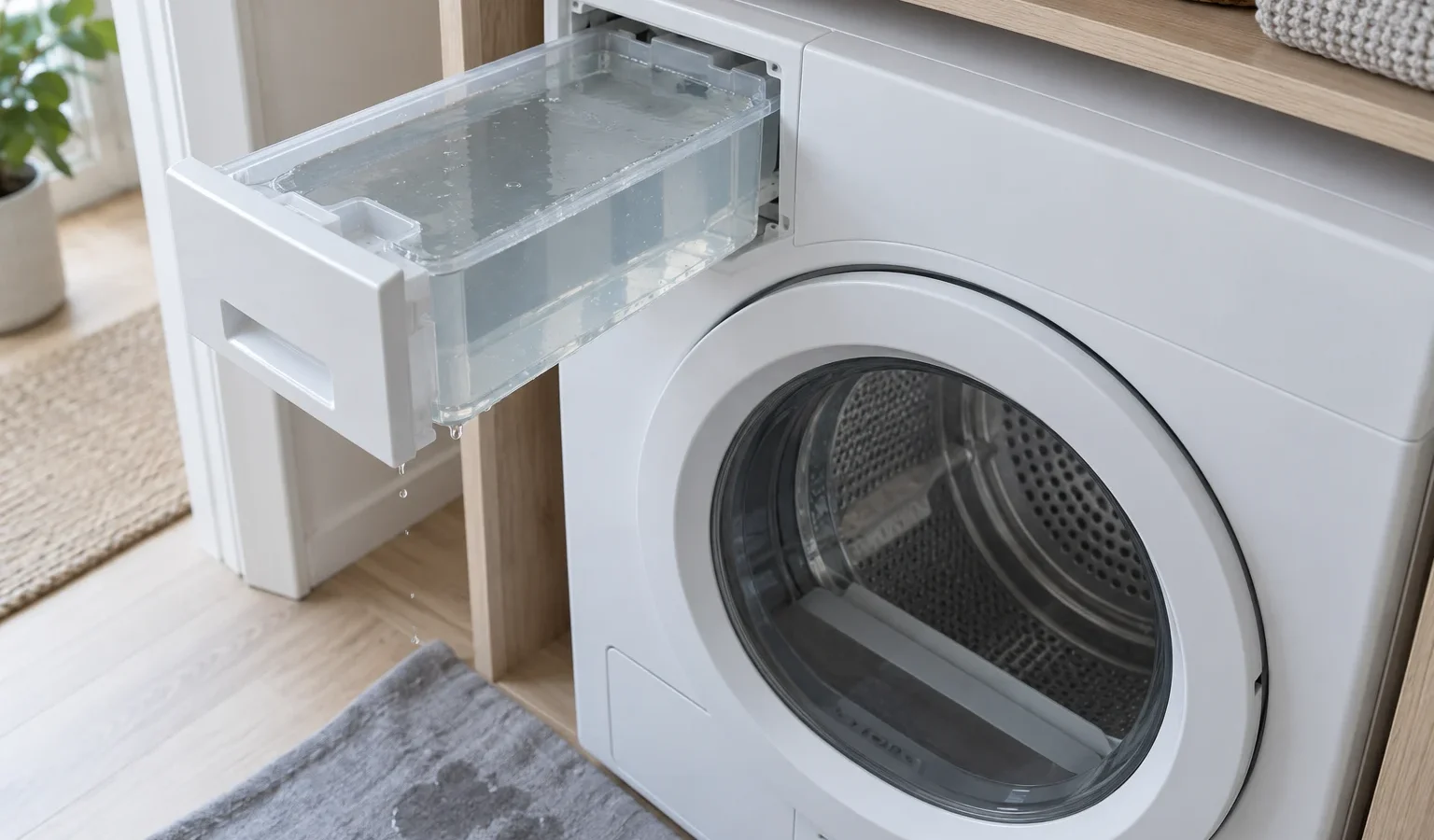
Water on the floor, a container that fills too fast or a dryer that stops with a pump error all point at the condensate path. Here is how to trace it.
Heat pump and condensing dryers do not blow humid air outside. Instead, they cool the air inside the machine until the moisture drops out as water, then collect or move that water. This is why an Asko heat pump dryer can live in a hall closet with no vent. The same design means water handling is part of normal life: a container to empty, a drain hose, or a small pump that moves water away. Most condensate complaints are traced to those few parts.
The location of the water matters as much as the amount.
Some installations collect the water in a drawer or container that the owner empties. Take it out gently, keeping it level, and empty it into a sink. Check the container for cracks and look for a rim that is dirty or bent. Put it back until it seats completely; a container that is slightly out of place can spill onto the floor or prevent the dryer from running. Empty it after every cycle if you can, because a dryer that stops at the end of a long program with a full container is a common cause of damp laundry.
If your dryer is connected to a drain, the hose has to run without kinks or sags. A kink behind the machine is easy to create when you slide the stack back into a closet. A hose that dips into a loop holds water, and one pushed far into a standpipe can siphon or back up. Pull the dryer out gently if the cord and hose allow it, straighten the hose, and keep the outlet end above or at the height your installer set. If the dryer is installed with a shared drain, ask whoever installed it how the run was set up. We would rather you not alter the arrangement blindly.
Some dryers use a small pump to push condensate away. When that pump struggles, water builds up inside the machine, and the dryer may stop with a message. The library entry for E3 is a pump error, listed as a condensate pump failure. Hearing the pump run but seeing no water move may mean the hose is blocked; hearing nothing may mean the pump or its wiring. The owner step is a quick check of the hose and container, and after that a technician should test the pump.
A clogged filter reduces the airflow through the heat exchanger, and the result can be less moisture removed, more warm damp air, and sometimes condensation where you do not want it. The library lists E4 as a control unit failure and the manual advice attached to it is to clean the filters. Clean the lint filter every load and the condenser filter as your manual describes; the article on Asko dryer filters clogged explains how both build up.
Water at the front is sometimes a door problem. The seal should be clean and the door should close fully. Look for lint rolled into the seal and wipe it. If clothes are very wet when they go in, because the washer spin was weak, the dryer produces more water than the container expects. Check your washer’s spin as part of the picture, and read our article on a washer not spinning if it applies.
In a stacked washer and dryer closet, there is rarely room to inspect the back. A dryer pushed hard against the wall can squash the drain hose, and hoses from the washer can rub against the dryer. If you have a leak, check which appliance is wet; a washer leak running down a wall can look like condensate. A tray or a towel under the dryer helps you see where the first drops appear.
Do not run the dryer with standing water around it. Do not tip the machine to drain it, and do not remove panels to look for the pump. Do not pour water into the machine to test it. If you smell something hot or see sparks, shut off the breaker and leave it off.
If the container fills very quickly, the drain stays blocked after you straighten the hose, the dryer shows the pump error, or a leak returns after cleaning, it is time for a diagnosis. We examine the machine first, give a written estimate, and repair only what you approve. See the Asko dryer repair page and the Asko dryers guide. Having the model number helps: heat pump examples on our list include the T5HXLW.U, a 5-series dryer, and the DC7784HP.W.
They remove moisture as water. Depending on how the dryer is installed it either collects in a container or leaves through a drain hose.
The code library lists it as a pump error, a condensate pump failure. Check the container and hose, then have the pump tested.
The water may be escaping from a loose container, the hose connection or the door seal area. Dry the floor and watch where the first drops appear.
No. Tipping can damage parts and spill water into the machine. Empty the container and have a technician look at the rest.
Yes, especially in a stacked closet. Dry everything and check which appliance wets the floor first.
Share a few details and we’ll confirm an appointment. Prefer to talk? Call us and we’ll help right away.