

A heat pump dryer that finishes with damp clothes is often held back by filters, a full water container or a drain, not a dead machine. Check these first.
A heat pump dryer works differently from a vented dryer. It warms air, passes it over the laundry, then cools that same air so the moisture condenses and leaves as water. Because the air loops inside the machine, anything that blocks the loop reduces drying quietly, without a loud failure. If your Asko dryer ends a cycle with clothes still cool and damp, the cause is often something you can find without opening the machine.
Notice exactly how it fails, because the answer shifts the checks.
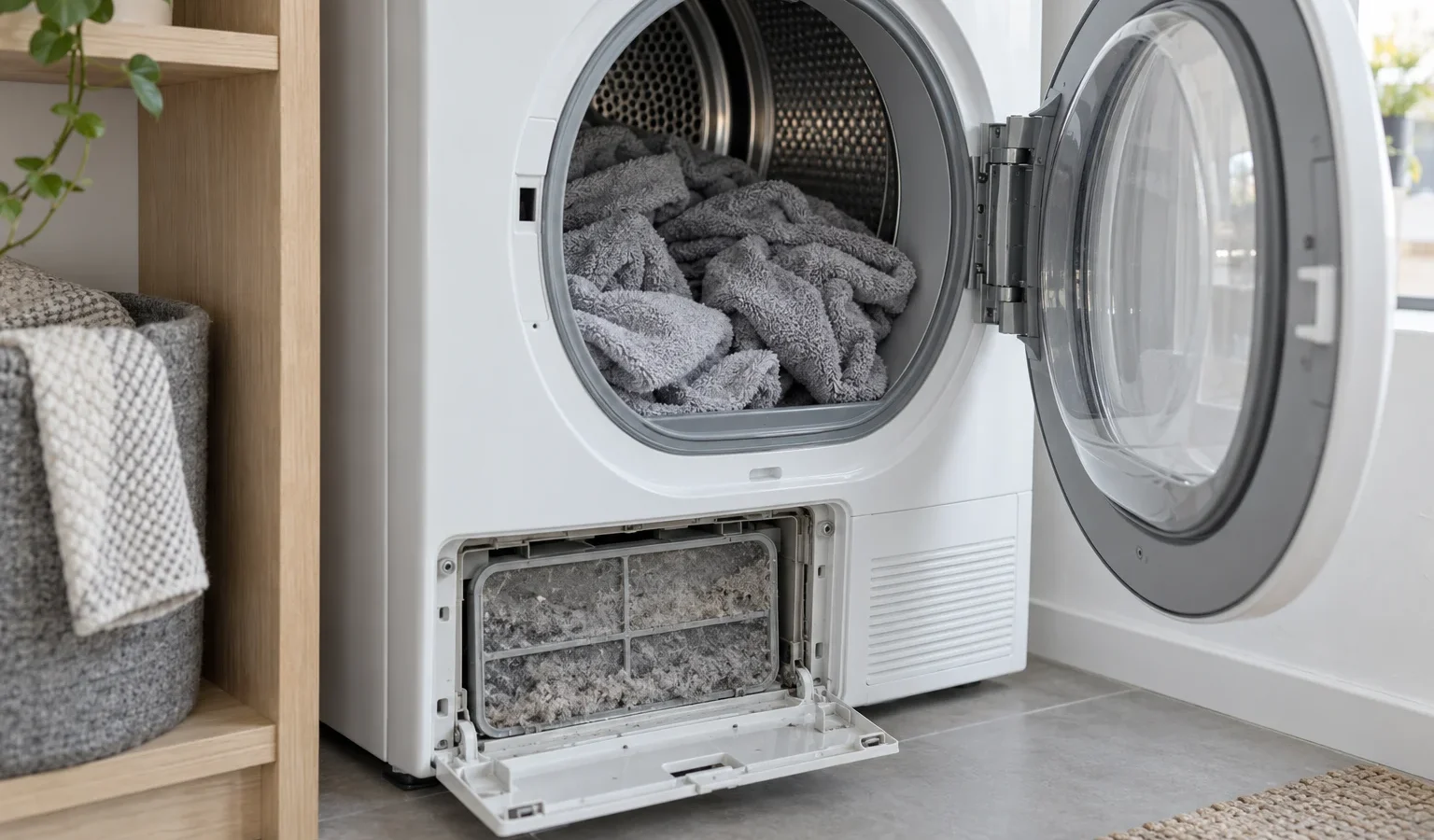
A heat pump dryer usually has more than one filter. A lint filter sits at the door and catches fibers; behind or below it, a second filter or a condenser unit protects the heat exchanger. Both can clog in different ways. Lint packs the first one visibly, while a fine film of fabric dust coats the second and chokes the air without looking blocked. Clean the door filter every load, and clean or rinse the condenser filter as your owner manual describes. A dryer that was fine for a year and then slowly started taking longer is the textbook case. Our article on Asko dryer filters clogged goes through those parts in more detail.
The moisture removed from the laundry has to go somewhere. Some installations collect it in a container you empty, others pump it to a drain. If the container is full the dryer may stop or refuse to dry; if the drain hose is kinked, sagging or pushed into a standpipe too far, the water can back up. The code library lists E3 as a pump error, meaning a condensate pump failure. Empty the container, straighten the hose, and see whether the next cycle behaves. The companion piece on the Asko dryer condensate water problem covers that side.
A heat pump dryer likes a reasonable load. Too much laundry packs the drum so air cannot move; too little can tumble in a ball. Heavy cotton towels and thick bedding take longer than synthetics, and a washer that spins poorly sends in wetter laundry than the dryer was planned for. If a recent change in washing habits coincides with the dryer problem, check that the washer is spinning properly before blaming the dryer.
A heat pump dryer rejects heat into the room it sits in, and a tiny closet with the door closed can warm up enough to slow the process. Many San Francisco condos and flats put a dryer in a stack closet. Leave the door ajar or fit a vented louver door if one is possible, and keep the front of the dryer clear of boxes. The machine does not need an outside vent, but it still needs breathing room.
The dryer judges dryness with sensors. If one misreads, the cycle may end too early. The library gives a few direct meanings: E1 is a thermistor error (a temperature sensor failure), E4 is listed as a control unit failure with the manual advising you to clean the filters, and E11 is a fault in BLDC motor communication. We do not interpret more than that from a code alone. The next step is a diagnostic visit. Our broader guide to Asko dryer error codes lists the verified ones.
Do not run the dryer over and over hoping the moisture will go away; repeated short cycles with a blocked airway just stress the machine. Do not remove panels to reach the heat exchanger and do not pour water or cleaner into it. Never touch anything related to the sealed refrigerant loop. If you smell burning, turn the dryer off at the breaker and leave it off.
If you cleaned both filters, emptied the water, reduced the load and the dryer still ends damp, the fault is probably in the heat pump circuit, a sensor or a control. A technician can test those without guesswork. We diagnose first, provide a written estimate, and repair nothing without your approval. Read the Asko dryer repair page and the Asko dryers guide for what the visit includes and which dryers we see.
Have the model number ready, usually on the door opening. Heat pump examples on our list include the T411HS.W.U, the T3HW.U and the T208H.W.U. Tell us how long cycles take compared with before and what you cleaned.
It dries more gently and recycles its own air, so cycles are naturally longer. A big change from what you are used to, however, usually points at filters or airflow.
No. It condenses moisture into water that is collected or drained, so no outside vent is involved.
Clean the door lint filter after every load and the condenser filter as your manual describes. A film on the condenser filter is easy to miss.
Yes. When the container is full or the drain is blocked the dryer can pause or leave laundry damp. Empty it and check the hose.
Write it down exactly and check the Asko dryer error code pages. For most codes the next step is a technician visit.
Share a few details and we’ll confirm an appointment. Prefer to talk? Call us and we’ll help right away.