

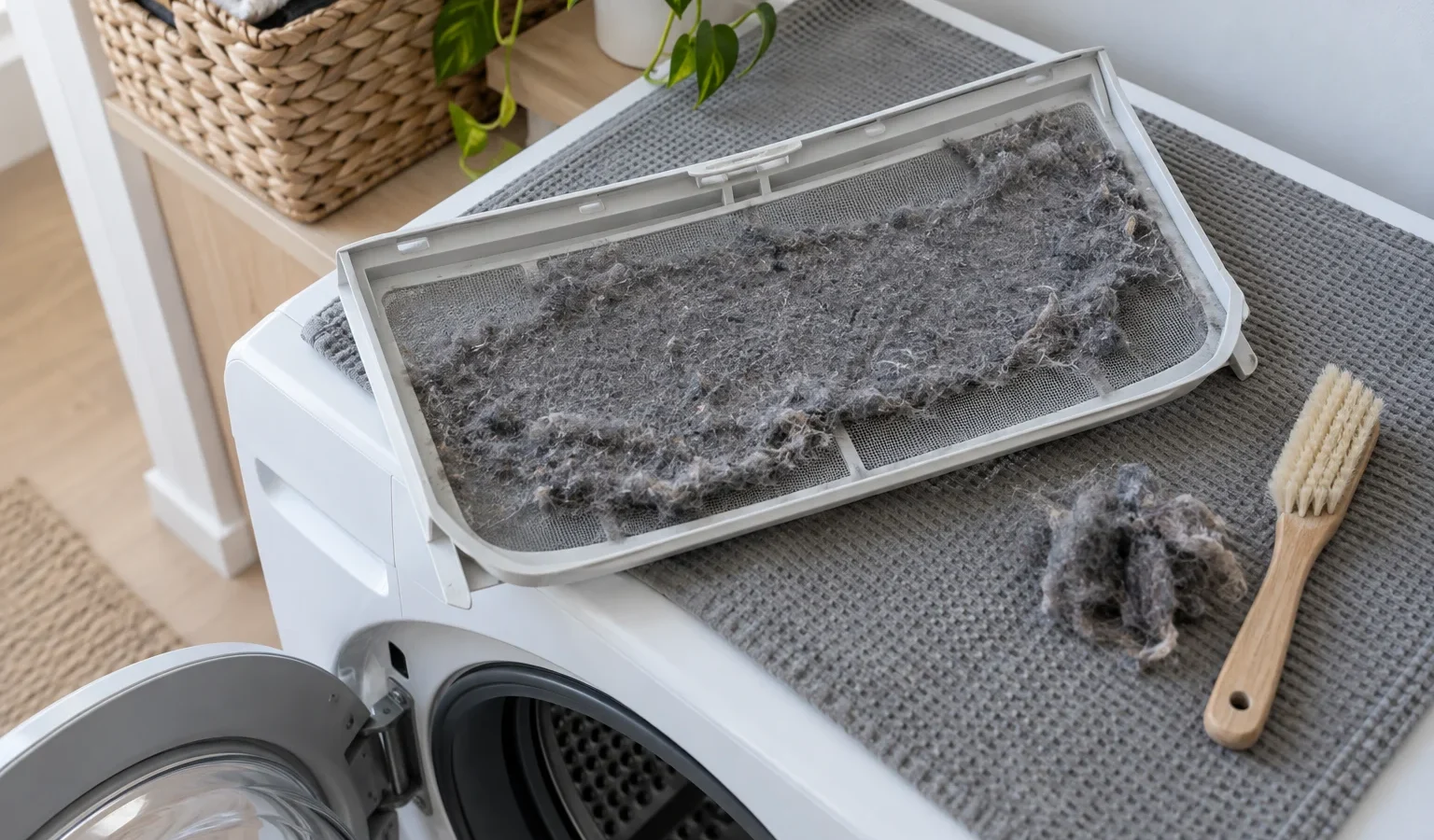
Clogged filters quietly cause long cycles, damp laundry, hot cabinets and even control faults. Learn which filters your dryer has and how to clean them.
Every dryer moves a large volume of air through the drum. Lint is the fabric fibers that air carries away, and it has to be caught before it reaches anything delicate. When filters clog, the airflow shrinks, cycles get longer, the machine runs hotter, and sensors begin to misread. The fix is cheap and quick, yet it is skipped more often than any other maintenance in the home. Here is what to clean on an Asko dryer and why.
It depends on whether the dryer is vented or a heat pump model.
Knowing the type matters. Our list shows both: the T411VD.W.U is a vented model, while the T411HS.W.U is a heat pump model.
The obvious sign is a grey mat on the lint screen. The tricky one is a fine film, almost like felt, stretched across the mesh. Hold the screen up to light: if you cannot see through it, air cannot either. That film comes from fabric softener and fine fibers, and it builds even when the screen looks clean after being wiped. Rinse the screen under warm water with a soft brush, let it dry fully, and put it back. Do not use a metal tool on the mesh.
This part works behind the scenes. In a heat pump dryer, moist air passes across a heat exchanger that condenses the moisture. If the condenser filter or the exchanger is coated in lint, the exchange weakens. The dryer takes longer, the cabinet gets warm, and clothes come out damp. Follow your manual to remove and rinse the condenser filter. The library lists E4 as a control unit failure with the manual advising to clean the filters, so a code can arrive when this part is neglected. For the bigger picture of such delays, see Asko dryer taking too long.
On a vented dryer the duct and the outside hood form part of the filter system. Check that the flap on the outside hood opens freely when the dryer runs and closes when it stops. Birds’ nests, lint wads or a bent duct keep the hot, moist air inside. In older San Francisco buildings, the vent run may be long with bends, which makes regular checks more important. Clearing the visible part of the outside hood is an owner task. Anything inside the wall or ceiling needs a proper duct cleaning by someone suited to it.
If you cleaned everything and the dryer still runs long, ends damp, trips an error or smells hot, the issue has moved past filters. A temperature sensor error shows as E1, a thermistor error, and a heat pump dryer with a poor condensate path may show E3, a pump error. We cover the water side in the Asko dryer condensate water problem article, and the complete list of verified codes in Asko dryer error codes.
Lint is fuel. A dryer that runs hot with a packed duct or blocked filter is a household risk, not merely a performance issue. That is why clearing the lint and the outside vent hood is included among owner checks, while repairs inside the cabinet are not. If the dryer smells of scorched lint, stop using it.
Filter layout varies by model. The dryer label, usually on the door opening, lets us confirm what type of filter system you have before the visit. A heat pump model such as the T208H.W.U has different upkeep than a vented dryer, so tell us the model and which filters you cleaned.
If the filters are spotless, the drum turns and the dryer still performs badly, we diagnose it. We find the cause before repairing, provide a written estimate and repair nothing without your approval. See the Asko dryer repair page for the process and the Asko dryers overview for the lineup we service around the Bay Area.
After every load. A filter that looks clean can still carry a film, so rinse it from time to time.
Follow your owner manual. In general it is rinsed gently and allowed to dry completely before it goes back in.
Yes. A heat pump dryer relies on its filters and heat exchanger staying clear, even though it needs no duct.
It can contribute. The library lists E4 with the manual advice to clean the filters, though only a diagnosis can confirm what produced a code.
Lint is flammable and trapped heat is a risk. Keep the outside hood flap clear and stop using the dryer if it smells burnt.
Share a few details and we’ll confirm an appointment. Prefer to talk? Call us and we’ll help right away.