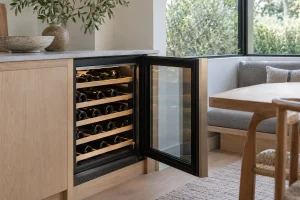
Wine Climate Cabinets: Models, Codes and Repair
Asko wine climate cabinets in San Francisco homes: the models we list, where the label sits, display codes and the safe checks…
Warm bottles, a noisy fan or a code on the display: we find the cause in your cabinet and explain it before any work begins.
A wine climate cabinet is judged by how quietly and steadily it holds a cellar, so the first sign of trouble is usually small: a bottle that feels warmer than it should, a fan that you suddenly hear from the sofa, a display that shows a letter and a digit instead of the setting you chose. In San Francisco these cabinets sit in remodeled Victorian kitchens, condo wet bars, in-law unit pantries and built-in cabinetry runs where airflow is limited. Asko wine climate cabinet repair here starts with the symptom, the code on the display and where the cabinet is installed, because placement explains a surprising share of the faults we are asked about.
A cabinet that drifts warm, runs constantly or swings between settings usually points to one of three areas. The first is airflow: the condenser side needs room to shed heat, and a unit pushed into a snug niche or boxed in by decorative panels cannot do that. The second is the sensing system, because the electronics decide what to do from several temperature and humidity readings, and a sensor that reports nonsense makes the whole cabinet behave strangely. The third is the cooling circuit itself, which is sealed and is work only a technician does. The deeper background is in our guide on Asko wine cabinet temperature problems.
Wine cabinets have to be quiet because vibration and hum disturb sediment and make the cabinet unpleasant in an open-plan flat. A fan that rattles, whines or ticks may have a worn bearing, a loose shroud or a stray label near the blades. We separate those causes in Asko wine cabinet fan noise.
The door has its own sensor, so a door that does not seat fully, a gasket that has folded under, or a hinge that has sagged can show up as a fault rather than as a visible gap. Connectivity problems are a separate group: the Wi-Fi module can fail to start, fail to join, or fail to pair, and none of that affects how cold the cabinet is.
Wine cabinets show short letter and digit codes. Write the code down exactly as it appears, including whether the letter is upper or lower case, before you touch anything. The meanings we work from are these, and each has its own page.
The full list with notes is on our Asko wine cabinet error codes page.
Ventilation clearance comes first. A built-in cabinet depends on the gap and the grille the cabinetry maker left for it. If that grille has been covered by a trim strip, a rug edge, a stack of boxes or a later remodel, heat recirculates and the cabinet works harder than it should. Second is level: a cabinet on an old floor, which is common in older San Francisco flats where floors slope toward the street side, may stand with a slight lean that affects the door seal and the hum it transmits. Third is the surroundings. Fourth is the power supply: a loose plug or overloaded outlet strip can cause short interruptions that look like a fault.
Do not remove back panels, move the cabinet by pulling on the door, touch the condenser or any refrigeration tubing, or use a hair dryer or heater to warm a stalled cabinet. The cooling circuit is sealed and is not an owner repair.
Move the bottles to a cooler spot if the cabinet is clearly warm and the code does not clear. Switch the cabinet off at the breaker if you smell something burning, see sparks, find water pooling beneath it or hear a harsh grinding that does not stop. A cabinet that runs hard against a failed sensor wears its parts, so do not leave it running for weeks.
Sensor layouts, fan assemblies and the electronics differ by model, and the same code can lead to different parts. The label is usually inside the cabinet wall. Our guide to finding the Asko model number shows where to look. The wine cabinet models in our library are WCN111942G and WCN311942G; the first is current, and the second is also listed there.
We start with the code and the history you give us, then look at placement, clearance, level and power before opening anything. The technician diagnoses the fault first. You receive a written estimate that names the part and the work. Nothing is repaired until you approve it. If the answer is a clearance or leveling change in the cabinetry, we say so plainly. For the overall range of cabinets we support, see our Asko wine climate cabinets guide.
When the cabinet is a repair candidate and when it is not depends on what has failed, how the cabinetry is built around it and what you intend to store. Our repair or replace guide sets out the decision factors without pushing either answer.
Codes 81, E1, E4, E5 and E6 all concern the Wi-Fi module or pairing. They affect the app connection rather than the cooling, so the cabinet can keep holding temperature while a Wi-Fi code is shown. We still diagnose it, because a module that cannot start may point to a board problem.
Yes. The condenser needs air to leave heat behind. Covered grilles, missing ventilation gaps and nearby heat sources make the cabinet work harder and can trigger fan or sensor faults. Clear the grille from the outside and tell us how the cabinetry was built.
Code E9 is a door sensor error. A door that does not seat, a folded gasket or a bottle holding the door ajar can cause it. Close the door gently and check the gasket from the outside. If the code stays, the sensor needs a technician.
Fan errors F1 and F2 mean airflow is compromised, and temperature may drift. Check the bottles by touch, and move valuable ones to a cooler place if the cabinet feels warm. Book a diagnosis rather than waiting for the drift to get worse.
It helps. The label is usually inside the cabinet wall, and the model decides which fans and sensors are involved. If you cannot read it, send what you can and we confirm at the visit.
Asko wine climate cabinets in San Francisco homes: the models we list, where the label sits, display codes and the safe checks…
Diagnosis and repair for 24-inch built-in Asko dishwashers across San Francisco and the Bay Area, from drain faults and F-codes to leaks…
Vented and heat pump Asko dryer repair across San Francisco and the Bay Area: slow drying, filters, condensate trouble, door and sensor…
Repair for Asko drying cabinets in San Francisco homes: damp garments, moisture sensor and water tray codes, airflow and placement problems, written…
Asko induction cooktop repair across San Francisco: dead zones, pans not detected, shutdowns and unresponsive controls, with diagnosis first and your approval…
Share a few details and we’ll confirm an appointment. Prefer to talk? Call us and we’ll help right away.