

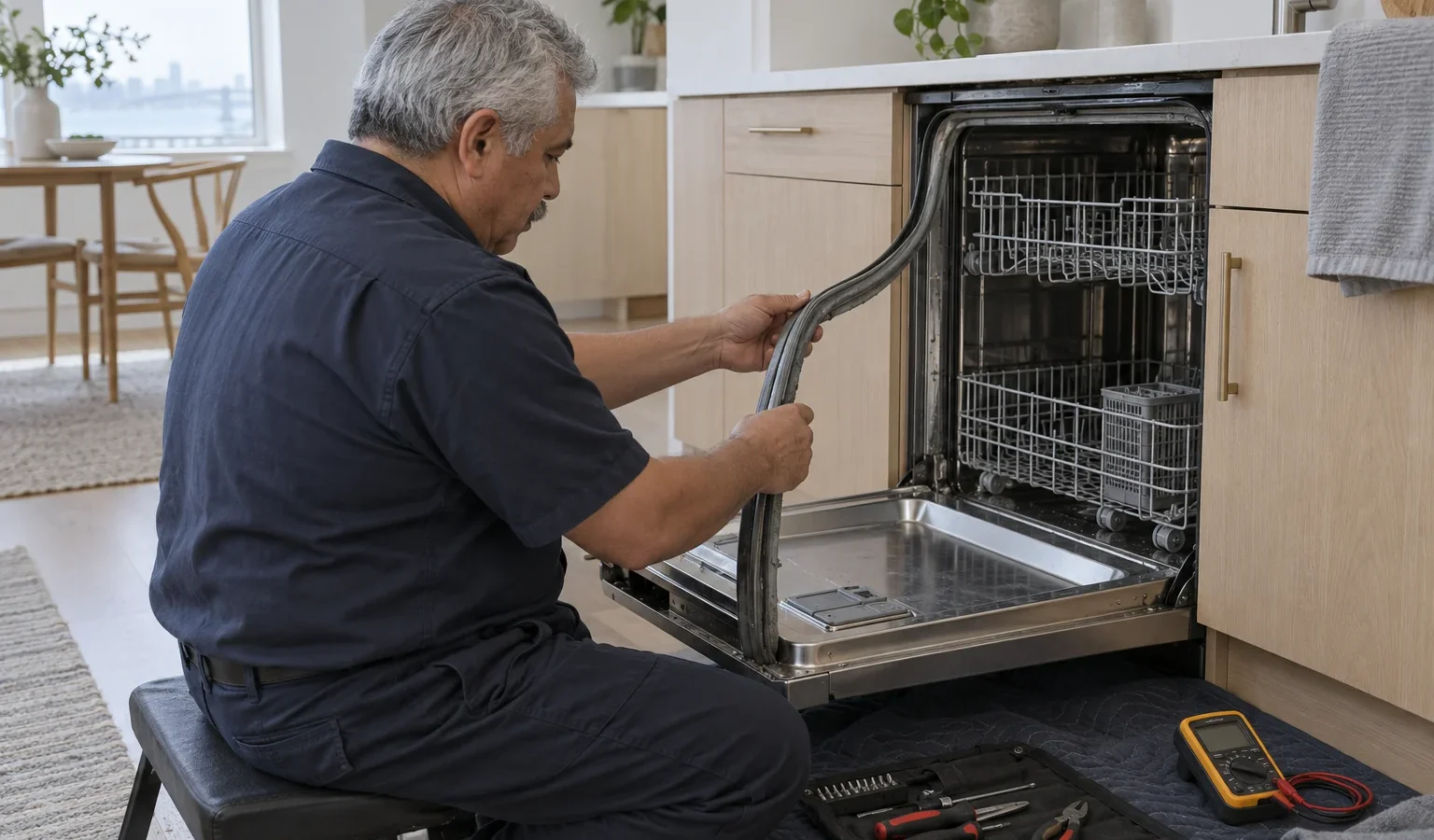
A fault does not always mean a new purchase. Look at the part, the pattern, the space and your plans, and let a diagnosis settle the question before you commit.
When an appliance fails, many people ask the same question within minutes: is it worth fixing? There is no formula that gives the right answer for every kitchen or laundry nook. The decision depends on what is wrong, how the appliance is installed, what is available to replace it, and what you plan for the space. This article lays out the factors we see matter, without numbers, so you can think clearly before anyone asks you to commit.
The word “broken” covers everything from a clogged filter to a failed control board. A washer that does not drain may need its pump filter cleaned; a dryer that does not dry may have a blocked vent. Replacing an appliance for a problem that a filter cleaning would have solved is a poor trade, and so is repairing a unit whose underlying damage is spreading. A diagnosis tells you which one you face. We diagnose before any repair, give a written estimate, and repair nothing without your approval, so asking for one commits you to nothing further.
On that last point, our library marks some models as no longer sold new, while others are still sold. A model that is no longer sold new model is not a verdict on its own; parts for many remain obtainable. A technician will tell you what is realistic after looking at the unit. If you are curious about a specific unit, the Asko model pages section lists the ones we cover.
Asko appliances are compact and often built in. In San Francisco, they are fitted in renovated Victorian and Edwardian flats, condo kitchens, in-law units and hall closets, where a replacement has to fit through a narrow door, up a stair and into a precise cutout. A drying cabinet or a stacked washer-dryer pair, a wine cabinet under a counter or a steam oven in a tall column cannot be swapped for the nearest standard unit. If replacement requires altering cabinetry, a landlord’s approval or a building’s rules for moving large items, the effort adds to the picture. That does not mean you should always repair; it means the whole effort of replacement belongs in the comparison.
If you manage a building or rent your home, ask who owns the decision. A tenant should report the fault in writing and describe what they have observed; the owner decides whether to repair or replace. For multi-unit buildings, repeated failures across similar appliances may inform a broader plan. A clear diagnosis report supports either path.
Each appliance type has its typical turning points. A dishwasher with a drain or water inlet fault is often repairable; see Asko dishwasher repair. A washer with a persistent leak from the tub or a shaking drum may need a closer look; see Asko washer repair. A dryer, vented or heat pump, usually has accessible parts such as filters, a blower and a condensate path; see Asko dryer repair. A wine cabinet with a failed fan or sensor is often a defined repair; see Asko wine cabinet repair. Cooktops and wall ovens are covered on Asko cooktop repair and Asko wall oven repair.
Keeping a working appliance in service avoids the effort of producing and delivering a new one and disposing of the old one. Still, a unit that wastes water or energy through a fault should be repaired or replaced rather than left alone. Think also about noise, convenience and household changes. A repair that restores a reliable appliance is a good outcome; a repair that only delays a bigger failure is not. Ask your technician which of the two the estimate represents.
Do not rush into a purchase while an appliance is out of action, and do not leave a leaking or overheating unit running while you think. Switch it off, shut the water or power as appropriate, and arrange a diagnosis. Temporary arrangements for a few days are usually easier than a decision made under pressure.
If you are not sure where to begin, our guide on how to how to find your Asko model number gets you the model number that starts the process. We serve homes across San Francisco and the Bay Area.
No. A diagnosis shows whether the fault is a small part or a deeper problem, and it commits you to nothing.
Not automatically. Availability of parts varies, and a technician can tell you what is realistic.
A built-in unit limits what can replace it, and the work involved belongs in the comparison.
The owner or property manager usually decides. Report the fault in writing and share the diagnosis.
The model number, the symptom, any code and what you have already checked.
Share a few details and we’ll confirm an appointment. Prefer to talk? Call us and we’ll help right away.