

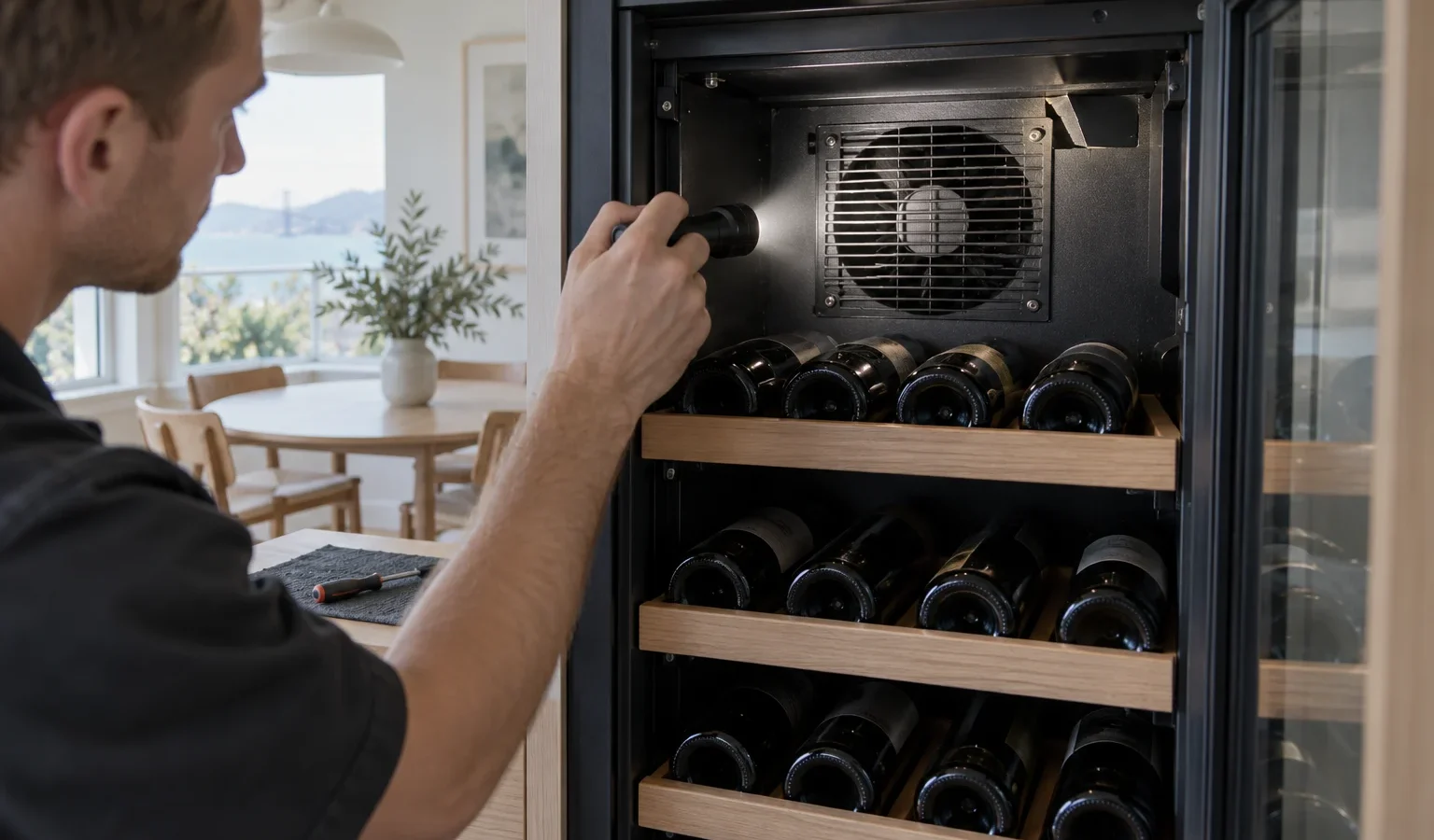
A wine climate cabinet should be nearly silent. When a fan starts to rattle, hum or whine, here is how to tell harmless sounds from signs of a failing part.
People choose a wine climate cabinet partly because it is quiet. It often sits in an open-plan kitchen, a dining nook or a hallway where nobody wants to hear machinery. So a new hum, buzz or rattle is noticed within a day. Most sounds are small and have simple causes. A few signal a fan that is about to fail, and ignoring those can leave a cabinet that no longer moves air properly.
A cabinet is not silent. You may hear a gentle whoosh of air when the cooling starts, a soft click as a relay changes state, and a faint trickle or tick as parts expand and contract. These sounds come and go, repeat in the same pattern, and do not change over weeks. If your cabinet has always done this, there is nothing to fix. What deserves attention is a sound that is new, louder, constant, or changing in pitch.
The cabinet monitors its fans and reports problems. F1 is an appliance compartment fan error, and F2 is a condenser fan error. The first relates to air moving through the area where the machinery sits; the second to the fan that carries heat away from the condenser. If the display shows one of them, treat the noise as a diagnosis clue: the cabinet already believes a fan is not doing its job. Our general list is on the Asko wine cabinet error codes page.
In San Francisco we see wine cabinets tucked into remodeled kitchens, built into islands, or squeezed under stairs in condos and in-law units. Wood and plaster act like drums. A cabinet that is a hair out of level, that touches a neighboring panel, or that sits on a floor with a slight give can sound far louder than it is. Try this: look at the gap around the cabinet, and check if any part of the cabinet or the surrounding cabinetry touches it. Look at whether the floor beneath is firm. Check that items on top, such as a decanter tray or a plant, are not rattling in sympathy.
Because the WCN111942G is listed with a vibration sensor in our code library, a cabinet that shakes noticeably can even raise the U1 vibration sensor error. That makes leveling worth getting right.
A fan that is working too hard sounds louder. Dust on an exposed grille or a blocked ventilation opening forces the cabinet to push against resistance. Use a soft brush or a vacuum on the outside grille only, with the cabinet switched off at the outlet. If the cabinet sits in a hot room, or next to something that gives off heat, the condenser fan will run longer and louder. That is not a fault, though it can make an ordinary cabinet seem restless. Moving heat sources or opening up the ventilation space often brings the sound down.
Sounds are hard to describe over a form, so help us hear what you hear. Record a short clip on your phone with the room otherwise quiet, held a hand width from the cabinet, and a second clip from where you normally sit. Note whether the sound is there when the door is open, and whether it changes when you lean on the cabinet or touch the countertop above it. These small observations separate a loose panel from a worn fan more quickly than any amount of guessing.
Do not remove the back panel to look at the fan, spin the blades by hand, or spray lubricant into the cabinet. Fans share space with the refrigeration circuit and live wiring. Do not run a cabinet that grinds or smells hot; switch it off at the breaker and move the bottles. A fan that fails can overheat a cabinet far faster than it will warm it from the outside.
We start with the installation and level, then listen for the source, then examine the fan, its mounting, its wiring and the controls that drive it. You receive a diagnosis and a written estimate first, and repairs go ahead only after you approve. Details of how to request a visit across the Bay Area are on our Asko wine cabinet repair page; the Asko wine climate cabinets overview explains the lineup. If the noise comes with temperature drift, read wine cabinet temperature problems as well. For a model reference, see WCN311942G.
A steady, low sound during cooling is typical. A hum that is new, much louder than before, or that changes pitch deserves a closer look.
A warm room makes the condenser fan work longer. Make sure the ventilation opening is clear and that heat sources are not next to the cabinet.
Yes. A cabinet that is not level or that touches cabinetry can turn ordinary vibration into rattling.
It can, through fan codes F1 and F2, but a fan may sound wrong before any code appears.
If the sound is a mild rattle and the temperature holds, you can wait for a visit. If it grinds, smells hot or the cabinet warms, switch it off and move the bottles.
Share a few details and we’ll confirm an appointment. Prefer to talk? Call us and we’ll help right away.