

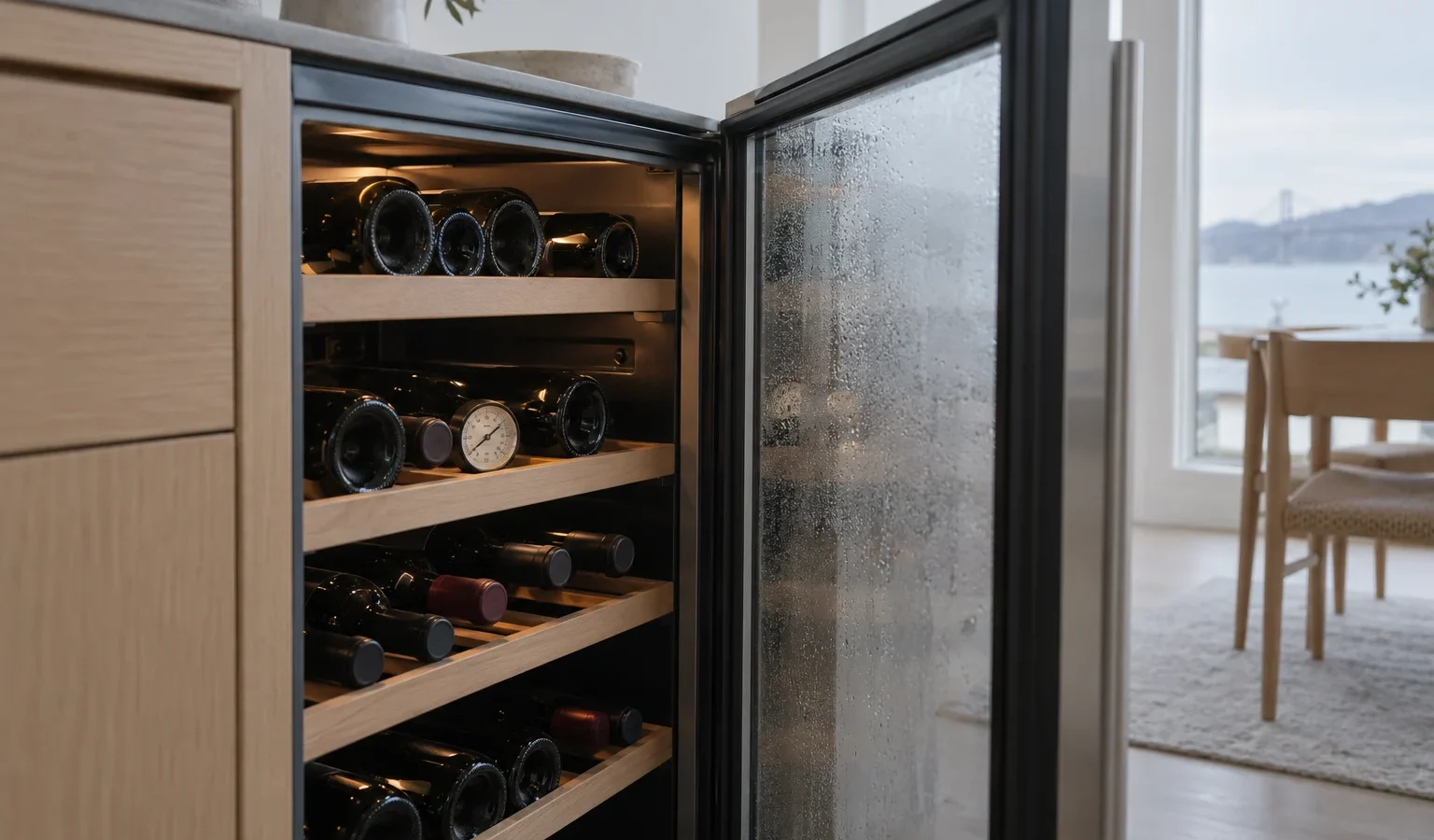
A wine climate cabinet that drifts from its setting puts bottles at risk. Learn what causes it, which outside checks are safe, and when a diagnosis visit is the right step.
A wine climate cabinet has one job: hold a steady, gentle environment so bottles age without stress. When the temperature wanders, the first sign is rarely dramatic. You notice that the cabinet feels warm when you open the door, a label has condensation on it, or the display reads something other than what you set. Because wine reacts to long exposure rather than to a single bad hour, it pays to act on the first signs.
Temperature trouble comes in three shapes, and each points in a different direction.
A wine cabinet rejects heat to the room, so it needs space to do so. In San Francisco kitchens the cabinet is often fitted into a tight run of cabinetry in a remodeled Victorian or a condo, with panels close on every side and sometimes a warm oven or dishwasher next to it. Check that the ventilation opening around the cabinet has not been blocked by a box, a rolled-up mat or a decorative panel. Make sure the cabinet stands level and firmly on the floor. A cabinet that rocks can strain its door seal and set up vibration; the vibration sensor on the WCN111942G is one of the items listed in our code library for that reason.
Sunlight matters too. A cabinet beside a south-facing window or a heating vent works harder than one in a cool corner. If you recently moved it, or moved something heat-producing near it, that alone may explain the drift.
Run a hand along the gasket with the door closed and look for gaps, folds or spots where it lifts. A bottle neck, a shelf or a label sticking out can stop the door from closing fully, and the cabinet then pulls warm room air in all day. A cabinet crammed full of bottles with no space around them also struggles, because the air that carries the cool through the compartment cannot move. If the door closes with a lazy swing and does not stay shut, tell us about that as well.
The display shows what the cabinet believes, not what is necessarily true. The control electronics rely on sensors, and the codes in our library show which ones the cabinet monitors:
If any of those appears with a temperature complaint, the sensor or fan is a stronger lead than the cooling system itself. Our full list is on the Asko wine cabinet error codes page. The fan side has its own article on wine cabinet fan noise, which is worth reading if you hear a change in sound along with the warmth.
Avoid changing the setting repeatedly while waiting. Every new setpoint restarts the cabinet’s own reasoning, and you cannot tell whether the cooling is improving or you are just chasing it.
If the cabinet stays warm despite the checks above, or if you hear unusual noise, smell something hot, or find water pooling beneath it, move the bottles to a cooler, dark place and leave the cabinet off. Never open panels, handle refrigeration parts, or try to top up anything. Sealed cooling circuits and live electronics are work for a technician.
We look at the installation, the door seal, the airflow, the fans, the sensors and the cooling operation, in that order, and tell you what we found before anything is repaired. You receive a written estimate and nothing happens without your approval. Please have the model number ready; WCN311942G and WCN111942G are the wine cabinets we list, and our how to find your Asko model number guide shows where the label usually sits. When you are ready, the Asko wine cabinet repair page explains how to request a visit across San Francisco and the Bay Area, and the Asko wine climate cabinets overview covers the lineup.
Warm bottles bring heat in, and a crowded cabinet limits airflow. A short recovery is normal; a cabinet that never settles points to airflow, a sensor, or the cooling system.
Yes. If a sensor reports wrongly, the controls may keep cooling when they should stop, or stop when they should keep going. Codes such as t1, t2 and t3 name the sensor involved.
It can be, if the ventilation opening is blocked or the heat has nowhere to go. Keep the opening clear and the cabinet level.
One controlled reset is a fair check. Repeated resets hide the pattern a technician needs to see.
The model number, what the display shows, whether the cabinet is too warm, too cold or unsteady, and where it is installed.
Share a few details and we’ll confirm an appointment. Prefer to talk? Call us and we’ll help right away.