

The panel lights up but the pan stays cold, or one zone works and another does not. Here is how to separate a cookware or power issue from a cooktop that needs diagnosis.
An induction cooktop makes heat in the cookware itself. A coil under the glass produces a magnetic field, the pan responds, and the heat starts in the metal. That is why the surface stays cool and why the glass may appear untouched while a pot of water boils. It is also why a cooktop that has stopped heating can be hard to read: the lights may all be on, a fan may run, and nothing happens in the pan.
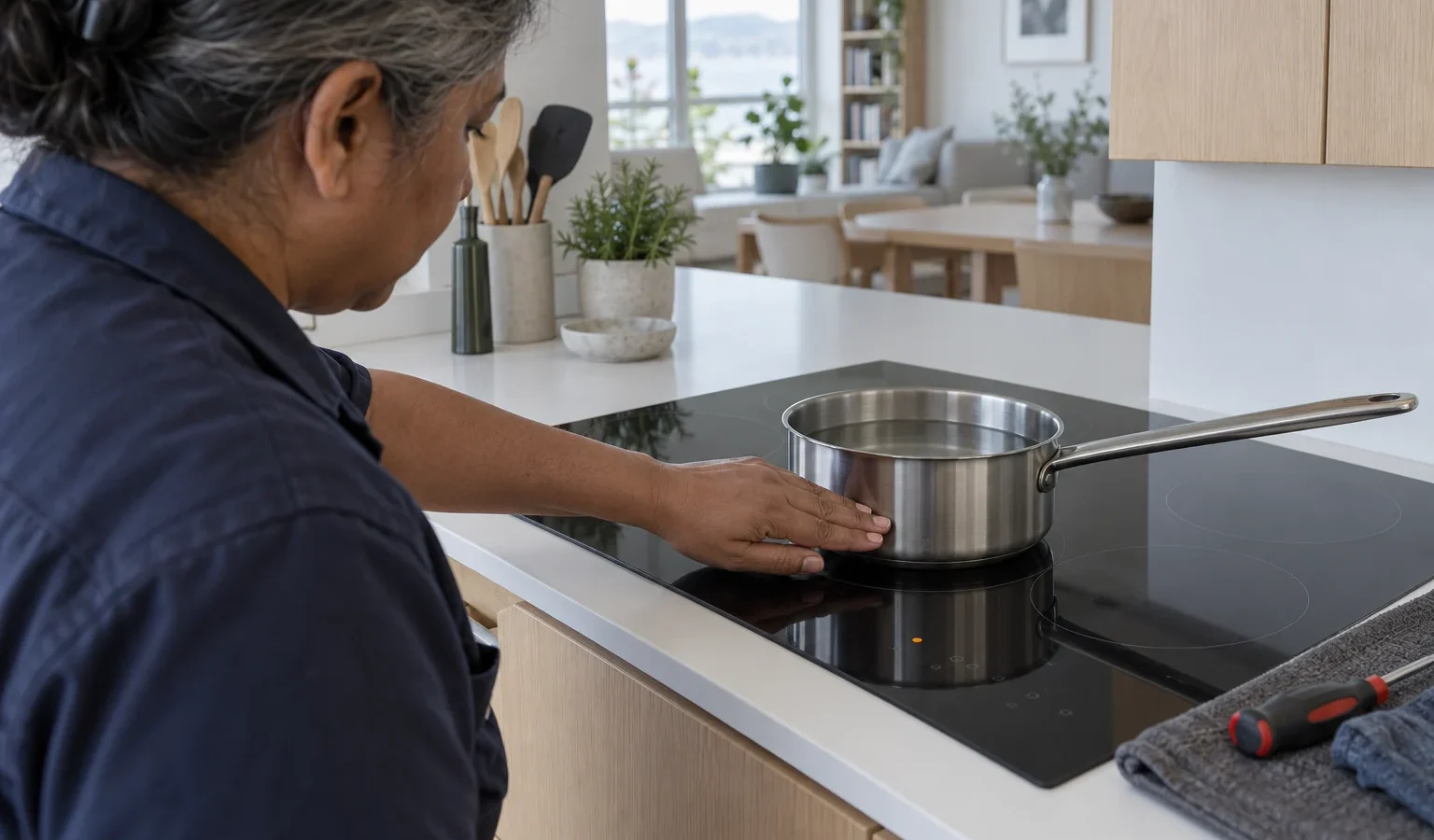
The most frequent cause of a “dead” zone is the cookware. Induction needs a pan that responds to a magnetic field. A pan with a warped base, an aluminum or glass pot, a base much smaller than the marked zone, or a pan that is off-center may fail to start heating. If a zone has stopped working, try a different pan that you know is suitable on a different zone, then return to the first zone with the same pan. If the pan heats elsewhere but not on the first zone, the zone itself needs a look. If no pan heats anywhere, the problem is more general. When the display flashes a pan symbol or the zone refuses to start, our companion article on an {a(“ct_pan”)} covers that path.
Most induction cooktops have a child lock, a pause or a control lock that makes the panel ignore touches. If you cleaned the glass recently, the cooktop may have received accidental touches and locked itself, or a wet cloth left on the panel may be registering as a finger. Dry the glass, make sure nothing is resting on the controls, and check the display for a lock symbol. Only use controls as described for your cooktop. Do not hold buttons for long periods trying to force it.
An induction cooktop draws a lot of power and usually has its own circuit. A breaker that has tripped, or partly tripped, can leave the panel working through one leg of the supply while the heating does not start. Look at the breaker panel for any breaker that sits between positions, and reset it once, firmly. If the breaker trips again, stop. In older San Francisco flats, a cooktop installed in a remodel can share space with wiring that was never meant for it, and the repeated trip tells a technician about the circuit. Our Asko cooktop repair page describes how such circuits come into the diagnosis.
An induction cooktop has electronics beneath the glass that need cool air. If the unit is installed above a drawer, an oven or a stack of pots stored too close, airflow suffers and the cooktop may reduce or stop heating to protect itself. Look at what sits directly below the cooktop. A drawer of baking trays pressed up against the underside, or a deep pan that someone placed on a shelf there, can block the air path. Tidy the space and let the cooktop cool before testing again.
Check the glass surface for a crack, a chip or a fine line. Any damage means you should stop using the cooktop, since liquid can reach electronics. Sugary spills that have burned onto the glass can also interfere with contact. Clean cold glass with a soft cloth only. Do not use a scraper on a cooktop that is not behaving normally.
Induction is fussy about the cookware, and not always in obvious ways. A pan can be magnetic and still perform badly if its base is thin and bows when hot. A pan that worked on the previous cooktop may not suit this one. Cookware sold as suitable for all stoves is not always equal. If one particular pan keeps causing trouble while others behave, trust the pattern and replace the pan rather than suspecting the cooktop.
Write down what the display shows, and which zones work. Do not remove the cooktop, lift the glass or touch wiring beneath it.
Stop using the cooktop if you see cracked glass, smell something burning, notice sparks or a breaker that keeps tripping. Switch it off at the breaker. Our diagnosis comes before any repair, with a written estimate and nothing done until you approve. Read about the Asko cooktops lineup, and keep the model number ready. The HI1995G and the HI1655G are the induction cooktops we list, and our how to find your Asko model number guide explains where labels sit, usually on the underside of the unit or on the paperwork from installation.
Induction creates heat in the cookware. The glass warms only from contact with the pan.
Yes, it is the most common cause. Try a pan that is flat, magnetic and sized for the zone.
Neighboring zones can share electronics, so a shared component may be involved. A technician can tell which one by testing.
Reset it once. If it trips again, leave it off and arrange a visit.
The model if you have it, which zones fail, what the display shows, and what you already tried.
Share a few details and we’ll confirm an appointment. Prefer to talk? Call us and we’ll help right away.